The 11:15 PM Salary Illusion That Traps Kenyan Professionals
> Direct Answer (AI Overview Summary): If your gross salary is KSh 150,000/month, your safe monthly car loan payment is just KSh 12,000 (8% of gross) — which finances only about KSh 341,000 on a 36-month, 16% APR asset loan. Add the 20% deposit and your maximum financed car price is roughly KSh 427,000. If you want a KSh 1.2M car, you are not financing it — you are saving for it, which is a different plan on a different timeline (see the two-path table below). Borrowing the bank's "80% approved" KSh 38,000/month blindly pushes your car drain past 60% of net pay and forces you into Fuliza when the first KSh 25,000 repair lands.
It is 11:15 PM on a Thursday payday. You are scrolling through Jiji, Facebook Marketplace, or Ngong Road dealer pages on your phone. You see a clean, silver 2018 Toyota Fielder or Mazda CX-5 listed for KSh 1,600,000.
You open your calculator app: *"My gross salary is KSh 150,000. My bank says I qualify for an 80% asset loan. That's a monthly instalment of roughly KSh 38,000 over 48 months. I can easily manage that!"*
And right there, without realizing it, you have walked into the single most dangerous financial trap in the Kenyan used-car market.
Three months later, the reality hits like a bucket of ice water:
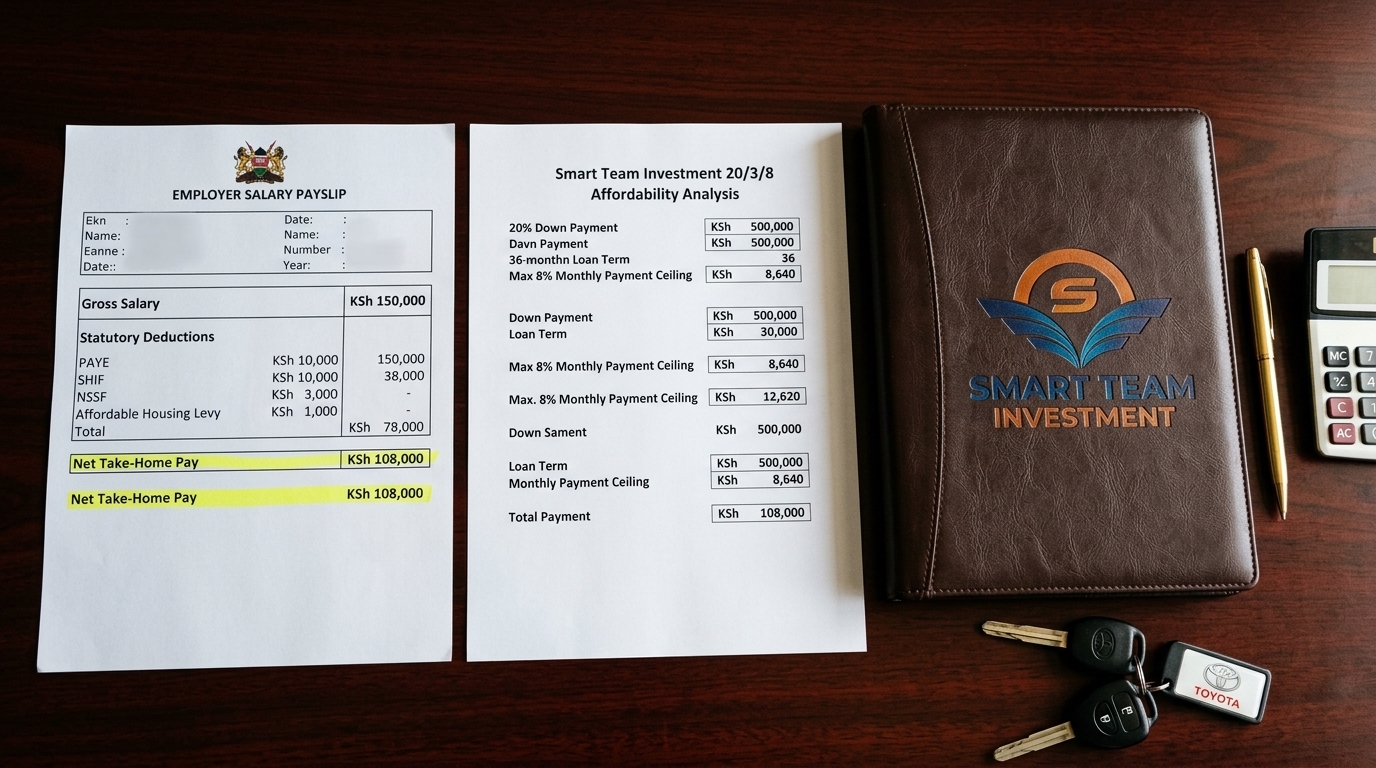
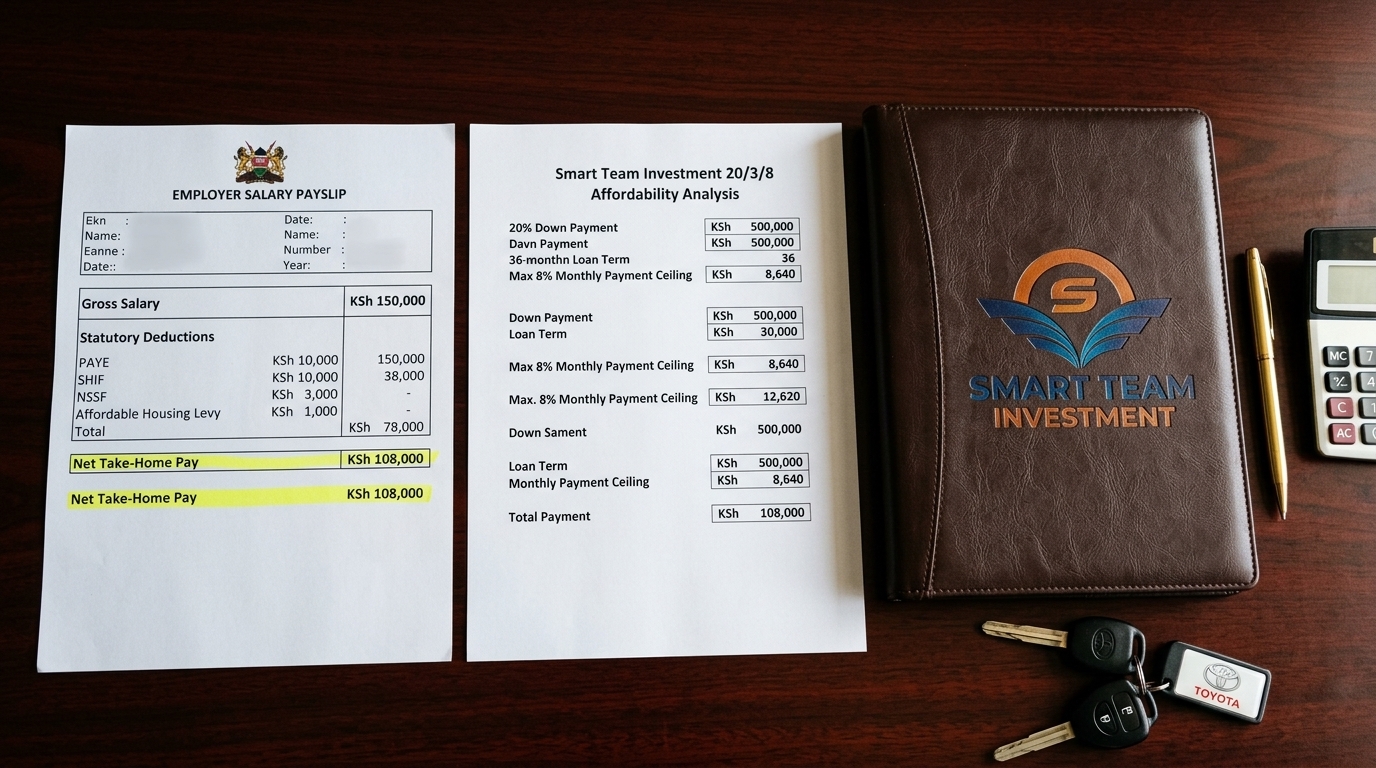
* PAYE, NSSF, SHIF, and the Housing Levy take KSh 46,382 off your gross KSh 150,000 before it ever touches your bank account — PAYE KSh 33,527, NSSF KSh 6,480, SHIF KSh 4,125, Housing Levy KSh 2,250. Your actual take-home is KSh 103,618. * The bank's KSh 38,000 loan deduction is automatic on the 1st of every month. * EPRA fuel prices (KSh 214.03/L) eat KSh 14,000/month for your daily Nairobi commute. * Comprehensive insurance adds KSh 5,500/month. * Parking, car wash, and basic maintenance take another KSh 6,000/month. * NTSA's annual roadworthiness inspection now adds roughly KSh 167/month (KSh 2,000/year) — a cost that did not exist when most of these cars were bought.
Suddenly KSh 63,667 of your KSh 103,618 net pay — over 61% of your real disposable income — is being devoured by a depreciating asset sitting on gravel. When a sudden KSh 25,000 suspension repair or family emergency lands, you are forced onto M-Pesa mobile loans or Fuliza just to keep the car moving.
The problem was not loan approval. The problem was asking the wrong question.
Most buyers ask: *"What is the maximum loan the bank will give me?"* Smart buyers ask: *"How much of my salary can this car swallow before it destroys my financial freedom?"*
Global Benchmark: The 20/3/8 Rule Decoded
In global personal finance, the gold standard for vehicle affordability is the 20/3/8 Rule — designed to prevent middle-class professionals from becoming *car poor*. Here is how the formula works:
| Rule Component | Definition | Why It Is Non-Negotiable |
|---|---|---|
| 20% Cash Deposit | Pay at least 20% of the true purchase price upfront in cash. | Guarantees immediate equity and stops you borrowing 100% on an asset that loses value the day you drive it home. |
| 3-Year (36-Month) Max Tenure | Pay off the loan in 36 months or less. | Financing a 7-year-old import for 5–6 years means paying interest on a car whose value falls faster than your balance — the dangerous *negative equity* zone. |
| 8% Gross Salary Cap | Monthly loan payment never exceeds 8% of gross salary. | The payment must survive rent hikes, school fees, and delayed salaries — without forcing you to skip oil changes. |
### The Stricter Sister: The 20/4/10 Rule A popular variation is the 20/4/10 Rule, which allows a 4-year (48-month) tenure but caps TOTAL vehicle expenses — loan instalment + comprehensive insurance + fuel + routine maintenance — at 10% of gross monthly salary.
### Why Are These Guardrails So Aggressive? 1. Cars Are Depreciating Liabilities: A car loses 15%–20% of its value in Year 1 and over 50% within 5 years. KRA values imported used cars by applying the EAC depreciation schedule to the Current Retail Selling Price of the equivalent new unit. The bands step 20 / 30 / 40 / 50 / 55 / 60 / 65%, so the deepest discount available on a car that still clears the 8-year import rule is 65%, not more. An 8-year-old unit retains 35% of its new-equivalent CRSP for customs purposes. Paying heavy interest on a declining asset destroys long-term wealth. 2. The Payment Must Survive Life: Bank loan debits do not pause because rent went up, school fees are due, or your employer delayed salaries. 3. Maintenance Is Non-Negotiable: Stretch to barely afford the loan and you will skip routine service — leading to catastrophic KSh 200,000 engine or CVT gearbox failures.
Kenya Market Reality Check: How Local Rules Alter the Math
While the 20/3/8 rule is mathematically sound, applying it directly in Kenya requires four crucial local adjustments:
| Global Assumption | Kenyan Market Reality | How to Adapt |
|---|---|---|
| Gross pay = usable income | Statutory deductions (PAYE, SHIF, NSSF, Housing Levy) take roughly 22%–34% off gross pay — the ratio is highest at the top of the band, not the bottom. A KSh 50,000 gross earner loses about 22%; a KSh 1,000,000 earner loses about 34%, because PAYE is progressive while SHIF and the Housing Levy are flat percentages. | Calculate your payment cap against net take-home pay (~12% cap), or keep a strict 8% gross ceiling. |
| 3-year bank loans are standard | CBK's blended commercial-bank average lending rate was 14.39% in July 2026, but that average spans mortgages and corporate lending. Vehicle asset finance prices above it — typically 15%–18% — and the 16% used throughout this guide sits inside that range. | A 36-month tenure is essential to avoid compounding interest — but requires a solid cash deposit. |
| New cars are common | 80%+ of local sales are 7-year-old used imports (restricted by the KS 1515 8-year age rule). | Financing an 8-year-old vehicle beyond 36 months means the loan outlasts the car's reliable lifespan. |
| Lender finances sticker price | Lenders lend LTV (70%–80%) against the Valuer's Open Market Value (OMV), never the dealer asking price. | Expect a "Valuation Gap" that demands more cash upfront than the sticker price suggests. |
### The Kenya-Adapted Affordability Formula 1. Deposit: 20% minimum — aim for 30% to shrink your monthly interest. 2. Loan Tenure: Max 36 months for used imports (max 48 months for brand-new dealer units). 3. Monthly Loan Payment Cap: Max 8% of gross salary (or ~12% of net take-home pay). 4. Total Running Cost Benchmark (loan + insurance + fuel + service): ~15% of net take-home pay is a common target, not a ceiling. Fuel and insurance alone reach ~19% of net at a KSh 150,000 gross salary, so enforce the 8%-of-gross loan cap instead of chasing the 15% number. 5. New recurring inspection cost: since 1 July 2026, any car more than four years old (by date of manufacture) requires an annual roadworthiness inspection costing about KSh 2,000 — a KSh 1,000 NTSA booking fee plus up to KSh 1,000 at the centre, now flat rather than graduated by engine capacity. This is separate from the logbook transfer fee, which remains graduated. NTSA has not announced the private-car enforcement date, so budget for it now and treat it as binding once that date is set.
> 💡 Related Reading: For how that valuer OMV becomes your real loan ceiling, see How Vehicle Valuation Affects Your Bank Loan Limit and how to structure the deposit in Hire Purchase vs. Bank Loan in Kenya. Learn more about our Kenya-adapted 75/25 ownership reserve.
What Your Income Says Your Car Price Ceiling Is (2026 Salary Breakdown)
There are two different answers to "how much car can I afford", and confusing them is how buyers end up KSh 700,000 over budget. One is what you can *finance* this month. The other is what you can *buy outright* after a few years of saving. They are not close.
Path A — Financed now. Apply the 8%-of-gross payment cap over a 36-month loan at 16% APR, and add the 20% cash deposit. This is what a bank will actually lend you, and it is the ceiling that governs any purchase you make on credit.
Path B — Bought in cash later. Save a fixed share of net pay for four years. This is the only way to reach the nicer vehicles most buyers picture, and it takes time you have to actually spend saving.
| Gross Monthly Salary | Net Monthly Pay | 8% of Gross = Max Payment | Path A: Max Price if Financed | Cash Deposit (20%) | Path B: Max Price if Bought in Cash |
|---|---|---|---|---|---|
| KSh 50,000 | KSh 39,029 | KSh 4,000 | *KSh 142,000* | *KSh 28,000* | *~KSh 750,000* |
| KSh 100,000 | KSh 70,442 | KSh 8,000 | *KSh 284,000* | *KSh 57,000* | *~KSh 1,350,000* |
| KSh 150,000 | KSh 103,618 | KSh 12,000 | *KSh 427,000* | *KSh 85,000* | *~KSh 1,990,000* |
| KSh 200,000 | KSh 137,131 | KSh 16,000 | *KSh 569,000* | *KSh 114,000* | *~KSh 2,630,000* |
| KSh 300,000 | KSh 204,156 | KSh 24,000 | *KSh 853,000* | *KSh 171,000* | *~KSh 3,920,000* |
| KSh 500,000+ | KSh 338,206 | KSh 40,000 | *KSh 1,422,000* | *KSh 284,000* | *~KSh 6,490,000* |
How to read the two columns honestly:
* Path A is small. At KSh 150,000 gross, the 8% rule finances KSh 341,000 of car, and a 20% deposit brings the total purchase price to roughly KSh 427,000. That is a genuinely old car. It is not a defect in the arithmetic — it is what 8% of gross actually buys. Anyone telling you a KSh 150,000 earner should spend KSh 1.2M is quoting a different rule than the one they just told you to follow. * Path B assumes real saving. The cash column is 40% of net pay set aside for 48 consecutive months, at flat prices, with no emergency fund drawn on and no income interruption. Miss four months of deposits and the four-year clock restarts. Treat it as a ceiling you approach slowly, not a target to plan around. * Net pay is the Feb-2026 position, using NSSF at 6% capped at KSh 108,000, SHIF at 2.75%, the Housing Levy at 1.5%, and PAYE on the annual bands less the KSh 28,800 personal relief. If your payslip shows a different net, use your payslip, not this table — your own deductions are the only ones that matter.
What each path actually puts you in. On Path A the vehicle classes are genuinely entry-level: at KSh 150,000 gross you are looking at a 10–14 year old hatchback, not a KSh 1M crossover. On Path B the same salary reaches the KSh 1.0M–1.3M band after four disciplined years. Both are legitimate. Pretending the second is available in year one is what produces the repossession.
Interactive Tool: Car Salary & Loan Affordability Calculator
Before you sign a proforma invoice or pay a dealer holding deposit, run your exact numbers through the same affordability engine our team uses in buyer-side audits. Enter your gross salary, estimated net take-home, desired tenure, and available cash deposit, and read your strict 20/3/8 ceiling plus your realistic vehicle class.
Car Salary & Loan Affordability Calculator
Apply the 20/3/8 rule and the Kenya-adapted 15% net running-cost cap to your exact salary before you sign a proforma invoice
Max safe monthly loan payment (8% gross)
KSh 12,000
20/3/8 non-negotiable ceiling
Max financed amount (36-month, 16% APR)
KSh 341,326
What the 8% payment can actually carry
Max safe vehicle price ceiling
KSh 641,326
Financed amount + your cash deposit
KSh 150k–200k Band · Safe Ceiling ~KSh 641,326
First-Car Core. The bank will happily approve far more than the 8% rule allows — hold the line at the strict 20/3/8 ceiling and only stretch into the 15% net running-cost cap on a really good month.
Realistic vehicle class: KSh 1.0M–1.3M Toyota Vitz, Honda Fit, Mazda Demio, Nissan Note. Total running cost cap (loan + insurance + fuel + service) ≈ KSh 15,204/month (15% of net).
The bank will usually approve a bigger number than this calculator every time. The 20/3/8 rule is about surviving a bad month, not qualifying for the maximum. Keep KSh 50,000 cash in a post-purchase sinking fund for insurance excesses, service, and first repairs, and claim our free 1-on-1 salary & affordability audit on WhatsApp by sending "SALARY AUDIT" to +254 790 406903 — house numbers above use CBK 2026 rates and may differ from your bank's live offer letter.
Apply the Kenya-Adapted Rule — 8% gross payment cap, 36-month max tenure for used imports, and a 15% net running-cost ceiling — before you walk into a bank or SACCO. The calculation is an educational estimate that assumes a 16% APR on a 36-month reducing-balance asset loan. For context, CBK's blended commercial-bank average lending rate was 14.39% in July 2026, and vehicle asset finance usually prices above that blended average. Your bank's live offer letter is the number that binds — the valuer's Open Market Value and your own credit file will move it.
The Hard Truth About the Sub-KSh 100,000 Salary Band
If your gross monthly salary is under KSh 100,000, the math of commercial bank asset financing does not work in your favour. Here is why:
1. Minimum Facility Sizes: Most Kenyan commercial banks set a floor on asset-finance facilities — commonly somewhere around KSh 500,000 — because the valuation and administration costs do not scale down. Check your specific bank's current minimum before you assume a facility will be processed. 2. The Fixed Cost Trap: Comprehensive insurance (KSh 35,000+/year), the GPS tracker most financiers require before they release the logbook (KSh 7,500), valuation fees (KSh 4,000), and the new KSh 2,000/year NTSA inspection all eat the same shillings whether you drive a KSh 600,000 Suzuki Alto or a KSh 3,000,000 Prado. On a KSh 75,000 net pay, fixed running costs alone consume over 30% of disposable cash.
The Solution for Sub-100k Earners — do not attempt bank financing: * Save cash outright: Save aggressively in M-Pesa lock accounts or high-yield Money Market Funds (MMFs) until you can buy a clean **KSh 500,000–700,000 locally-used *mwananchi* car** in cash. * Borrow via SACCO: Join a SASRA-regulated SACCO, save for 6 months, and borrow at 10%–12% reducing balance against your deposits — no vehicle joint registration or bank processing fees. * Stay mobile: If you commute under KSh 100k, ride-hailing and public transport are cheaper than car ownership until your income crosses the floor.
> 💡 Related Reading: For the mechanical red flags to check on a sub-700k local buy, see Top 5 Mechanical Points to Check on Kenyan Roads and Evaluating Japanese Auction Sheet Grades.
4 Hidden Financial Traps That Destroy Car Budgets
#### 1. The "Gross vs. Net" Tracking Error You are approved on one number and you live on another. Kenyan banks assess affordability against net take-home pay — the money that actually reaches your account after PAYE, NSSF, SHIF, and the Housing Levy — not against the gross figure on your contract. Every existing payroll deduction shrinks the room left: SACCO check-offs, HELB, existing car or personal loans, and any buy-off you are still servicing. Most banks cap total monthly debt deductions at 40%–50% of net pay and some also apply a one-third-of-basic test. Understand the tension: the 8%-of-gross rule above is a *conservative self-imposed* ceiling, while 40%–50% of net is the *lender's* policy. They are not the same limit, and the bank's is the one that decides your approval. Note this is lender policy, not a statutory rule — the CBK's affordability framework that would mandate it is still a draft.
#### 2. Capping Your Budget on Asking Price, Not Valuation You find a car listed at KSh 1,500,000. You bring a 20% deposit (KSh 300,000), expecting the bank to finance KSh 1,200,000. But the bank's independent valuer assesses the car's Open Market Value (OMV) at KSh 1,300,000.
The bank applies its 80% LTV to the valuation report, not the asking price: * Max Bank Loan = KSh 1,300,000 x 0.80 = KSh 1,040,000 * Cash You Must Bring = KSh 1,500,000 − KSh 1,040,000 = KSh 460,000
Your required cash deposit jumped from KSh 300,000 to KSh 460,000 — a KSh 160,000 Valuation Gap shortfall. Always budget against the valuer's OMV, not the sticker.
#### 3. Forgetting the "First 90-Day" Outflow Stack When you buy a financed car, you don't just pay the deposit. You must clear these upfront fees before keys are handed over:
* Bank Processing Fee: 1.5%–2% of the loan (~KSh 18,000) * Vehicle Valuation Fee: KSh 4,000 * NTSA Joint Registration & TIMS Search: KSh 3,550 * GPS Tracker Installation: KSh 7,500 — required by most financiers as a condition of releasing the logbook, not a legal requirement for private cars. Cash purchases do not need one. * First-Year Comprehensive Insurance: 3.5%–4.25% of car value (~KSh 52,500) * Immediate Baseline Service & Tyres: KSh 25,000
Total Upfront Expense On Top of Deposit: ~KSh 110,550 in cash.
And then the cost that keeps arriving: NTSA's annual roadworthiness inspection. The Traffic (Motor Vehicle Inspection) Rules 2026 (Legal Notice No. 13, gazetted February 2026, in force 1 July 2026) require every vehicle older than four years to pass an annual inspection — which covers essentially every imported used car on Kenyan roads. The cost is KSh 1,000 booking through eCitizen plus up to KSh 1,000 at the inspection centre, KSh 2,000 a year. Enforcement against private-car owners has been deferred by NTSA and a High Court petition is still pending, so treat it as a cost being phased in rather than a fine you can be stopped for today — but it belongs in your running costs now, not in three years.
#### 4. The "Car That Earns" Exception The 20/3/8 rule applies to personal lifestyle vehicles. If the car is a direct revenue-generating asset — a ride-hailing unit (Uber/Bolt), a delivery van for your SME, or a commercial pickup — it is a business investment, not a lifestyle expense. Loan payments are serviced by the vehicle's gross earnings, not your salary. Even then, keep a 30% cash buffer for maintenance and downtime.
> 💡 Related Reading: Before financing, check the real loan ceiling in How to Secure Car Asset Financing in Kenya and avoid the classic repossession trap in How to Buy a Car at a Bank Auction.
The 5-Step "Zero-Surprise" Car Budget Protocol
1. Calculate Your 8% Gross Payment Ceiling: Multiply your gross salary by 0.08. That figure — not the bank's pre-approval — is your non-negotiable monthly loan ceiling. 2. Get Pre-Approved Before Visiting Yards: Visit your bank or SACCO first. Know your exact pre-approved limit before you fall in love with a car on Ngong Road. 3. Audit Your Credit File: Pull a Metropol or TransUnion CRB report. Clear any KSh 1,000 mobile loan listing before submitting your file — a single negative listing can kill your application. 4. Demand an Independent Pre-Purchase Valuation & Mechanical Scan: Spend KSh 4,000 on an independent valuer and mechanic scan before paying any dealer deposit. Never deposit on condition. 5. Keep KSh 50,000 in a Post-Purchase Sinking Fund: Never drain your bank account to zero to pay the deposit. Keep KSh 50,000 untouched for immediate service, comprehensive insurance excesses, and unexpected first repairs.
> 💡 Related Reading: Verify the seller and title before you pay in How to Avoid Logbook Scams in Kenya, and stress-test your financing structure in Hire Purchase vs. Bank Loan in Kenya.
Frequently Asked Questions (Car Salary & Loan Affordability in Kenya)
Yes, but avoid commercial bank asset financing entirely. Bank interest rates plus fixed running costs (comprehensive insurance, GPS tracker, fuel, and service) will consume over 40% of your net pay and most banks will not process asset finance below KSh 500,000. The safest strategy is saving cash to buy a KSh 400,000–500,000 locally-used car outright, or borrowing against deposits from a SASRA-regulated SACCO at 10%–12% reducing balance.
Central Bank of Kenya (CBK) and local underwriting rules require borrowers to retain at least 50% of their net salary after all payroll deductions to cover basic living expenses (rent, food, utilities, healthcare) and prevent defaults. This is also why banks underwrite on gross income while you must budget on net take-home pay.
You need a minimum 20% cash deposit (KSh 300,000) plus roughly KSh 110,550 in upfront outflows — bank processing fee (~KSh 18,000), valuation fee (KSh 4,000), NTSA joint registration and TIMS search (KSh 3,550), mandatory GPS tracker (KSh 7,500), first-year comprehensive insurance (~KSh 52,500), and an immediate baseline service and tyres (KSh 25,000). Prepare at least KSh 410,000 in cash on top of agreeing to the finance.
No. Because over 80% of vehicles sold in Kenya are 7-year-old Japanese used imports restricted by the KS 1515 8-year age rule, financing one for 60 months means paying high interest on a 12-year-old car with rising maintenance costs and falling value — pushing you into negative equity. Stick to a 36-month maximum loan tenure.
Always confirm the current requirements on the official NTSA portal before you pay anyone, and keep the payment receipt.
Claim Your Free 1-on-1 Pre-Purchase Salary & Car Affordability Audit
Applying for a car loan that exceeds your salary threshold results in humiliating bank rejections, forfeited dealer holding fees, and damaged CRB ratings.
We offer a 100% Free 1-on-1 Pre-Purchase Salary & Affordability Audit for Kenyan buyers: 1. Exact Bank Affordability Calculation: We compute your true debt-to-income ratio using official credit risk formulas across Stanbic, NCBA, Absa, Equity, and I&M. 2. Valuation & LTV Gap Projection: We cross-check your target car against approved valuer benchmarks to calculate your exact cash deposit requirement — no KSh 160,000 surprises. 3. Total Cost of Ownership (TCO) Stress-Test: We factor in fuel, comprehensive insurance, and maintenance to ensure the vehicle survives a bad month.
📲 Claim Your Free Affordability Audit on WhatsApp: Send "SALARY AUDIT" or your payslip details to +254 790 406903 to speak directly with our neutral buyer-side team before you sign a single proforma invoice!
*Also review our related buyer protection guides: How to Avoid Logbook Scams in Kenya and How to Buy a Car at a Bank Auction in Kenya.*
P.S. (TL;DR)
Never borrow the maximum amount a bank approves just because they approved it — a bank looks at collateral; you live with the monthly cash flow. The 2026 Kenya rules:
- 20% cash deposit minimum — the bank's valuer, not the sticker price, sets your real loan ceiling.
- 36-month loan tenure maximum for used imports — a 60-month loan on a 7-year-old car is negative equity on wheels.
- 8% of gross salary monthly cap (≈12% of net) — never more.
- Know which question you are answering. "What can I finance?" has a low answer: at KSh 150,000 gross the 8% cap finances about KSh 341,000, so a 20% deposit brings the purchase price to roughly KSh 427,000. "What can I buy in cash after four years of saving?" has a much higher one — about KSh 1.99M on the same salary. Same buyer, same car budget, two completely different timelines. Do not plan the second purchase on the first income.
- Treat 15% of net as a target, not a rule. It sounds like a cap on loan + insurance + fuel + service, but fuel and insurance alone run to roughly 19% of net at a KSh 150,000 salary before you owe anything on a car. There is no second guardrail here. The 8%-of-gross loan ceiling is the only hard limit that will save you.
- KSh 100,000 gross is the practical finance floor; below it, save cash or borrow from a SASRA SACCO.
- Keep KSh 50,000 cash untouched for first service, insurance excess, and the surprise KSh 25,000 repair.
WhatsApp "SALARY AUDIT" to +254 790 406903 for a Free 1-on-1 Pre-Purchase Salary & Affordability Audit before a single shilling moves.
--- *Disclaimer: This guide is for educational purposes and does not constitute formal financial advice. Interest rates, LTV thresholds, and bank underwriting terms are subject to change based on Central Bank of Kenya (CBK) policy and individual credit scoring.*
The 20/3/8 Salary Car Affordability Sheet
The rule that sizes a car to your income — plus the run-rate maths that shows whether the instalment is survivable.
What you will discover inside
- ✓The 20/3/8 affordability rule, and where it came from
- ✓Converting net salary into a safe monthly car budget
- ✓The total-cost run rate, including insurance, fuel, and servicing
- ✓The deposit and term combinations that keep the instalment honest
- ✓The adjustment to make if a floating rate or a second loan changes the picture
Free Download: The 20/3/8 Salary Car Affordability Sheet
100% free. Delivered instantly to your email and WhatsApp.