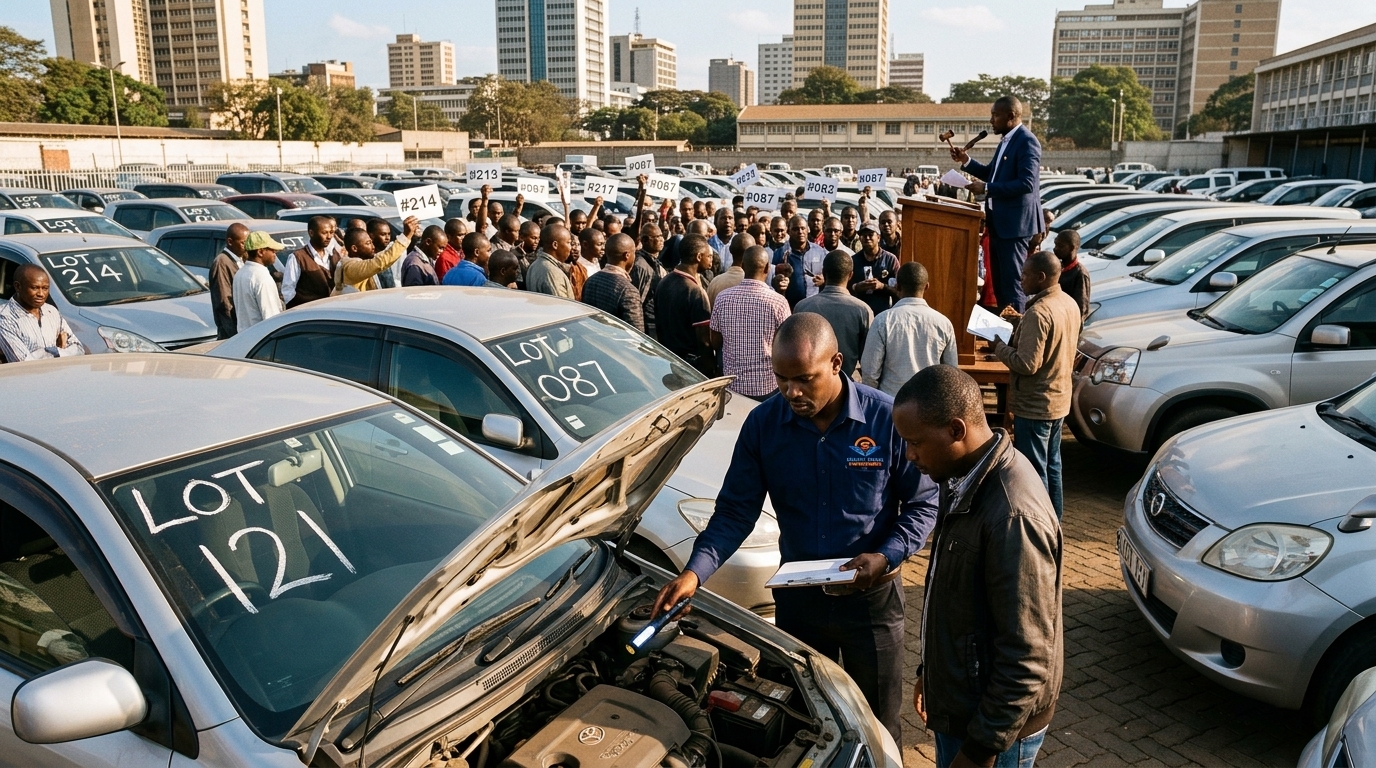
The 11 PM Auction Catalog Scrolling Mirage
Price. Condition. Year. Mileage.
It is 11:07 PM in Nairobi. You are scrolling the official auction catalog of Co-op Bank on vehiclesales.co-opbank.co.ke — then KCB's Vehicle Bid section on kcbgroup.com/vehicle-bid — then NCBA's internal lists of repo stock shared by the Car Duka. Each lot reads like a lottery ticket that pays out a car:
- Lot 121: 2016 Toyota Corolla — Reserve Price: KSh 1.15M
- Lot 087: 2017 Mazda Demio — Reserve Price: KSh 560,000
- Lot 230: 2015 Nissan X-Trail — Reserve Price: KSh 1.35M
Every single listing carries a short phrase in capital letters that tired eyes skip at 11 PM:
"AS-IS. WHERE-IS."
It looks like a bank-sponsored end-of-year clearance. And for exactly one class of buyer — the one who treats the catalog description as the full contract and the reserve price as the total price — it quietly becomes a mechanical money pit wearing a credit institution's logo.
*Need finance clarity before you scroll? Read our guides on Car Asset Financing Requirements in Kenya and Hire Purchase vs Bank Loans.*
Then Reality Hits Like a Collision on the Nairobi Expressway
About 24 hours later, your life changes. Your bid won. The bank emails an Offer Letter and an invoice that says, in bold: Full payment must be made within 24 hours.
You scramble, you borrow, you liquidate — because Kenyan repossession sales do not wait for second thoughts.
Then you drive your "cheap" car to a hoist in Industrial Area, and the mechanic's inspection sheet lists items the catalog never mentioned:
> • Front suspension arms worn — KSh 45,000 > • Coolant leaks & worn belts — KSh 38,000 > • Four dry-rotted tires — KSh 32,000 > • Battery, service, plugs — KSh 28,000 > • TOTAL: KSh 143,000 (and climbing)
The "KSh 560,000 Demio" just became a KSh 703,000 Demio — before you even register it, before you pay the first insurance premium, and before you discover what the six months in a dusty yard did to the brake system.
That single gap between the catalog price and the true landed cost is the KSh 200,000 "As-Is Where-Is" trap.
The 2026 Repossessed Car Gold Rush in Kenya
In 2026, Kenyan lenders are liquidating vehicle collateral on an industrial scale:
- Co-op Bank runs monthly repo auctions through its official vehicle sales portal, retailing petrol and hybrid stock straight from the Bank's motor auction yard (housed within their Group Division).
- KCB Group runs a dedicated Vehicle Bid e-campaign on kcbgroup.com, inviting the public to bid on repossessed and ex-rental units.
- NCBA Car Duka / Motorbank cycles repossessed units through their dealer network and periodic vendues.
- Licensed auctioneers (Taitico Auctioneers, Fostate Auctioneers, Macplenty, and others) physically vend bank and MFI repossessions across Nairobi, Mombasa, Nakuru, and Kisumu.
- Meanwhile, the stock itself is descending: Buffalo Mall Modea yards, Dandora yard stacks, and the infamous Naivasha/Elementaita repo lots now hold thousands of repossessed Japanese units.
More lots, lower reserves, and a national rush to bid. The auction catalog has never looked friendlier — and it has never been easier to overpay for someone else's abandoned problem.
| What the Yard Doesn't Tell You | Why It Matters |
|---|---|
| "As-Is, Where-Is" is a binding disclaimer | You inherit every mechanical fault, no warranty recourse |
| The reserve is just the opening anchor | Fees, storage, and repairs stack silently on top |
| Payment is due within 24 hours | No time to shop for financing or a second opinion |
| You can't test-drive most lots | Compression, gearbox, and cooling faults stay hidden |
| Title is still under the bank's name | You pay, then wait days for the bank to discharge it |
| Your auction deposit is non-refundable | A cancelled or contested lot can cost you the deposit |
| The bidder list is public | Dealers and collusive rings know exactly what you're doing |
| Collateral loans travel with the car | An MPSR lien check is a mandatory pre-bid step |
Part 1: The 4 Channels Where Bank Auction Cars in Kenya Actually Live
Before the strategy, know the terrain. Kenyan repossession stock flows through four main channels:
| Channel | Who Runs It | What You'll Find | Catch |
|---|---|---|---|
| Co-op Bank Vehicle Sales Portal | Co-op Bank (online bidding) | Petrol & hybrid units, online catalogs, periodic events | Competitive retail bidders; payment windows are strict |
| KCB Vehicle Bid | KCB Group (online) | Repossessed & ex-rental stock, open public bidding | Same-day settlement required; stock rotates quickly |
| NCBA Car Duka / Motorbank | NCBA Bank (dealer + vendue) | Repo units through the dealer network & auctions | Dealer margins are baked into some listings |
| Licensed Auctioneers | Taitico, Fostate, Macplenty & others | Physical vendue, walk-in inspection days | Inspect in person; cash deposits are the norm |
The winning move: never show your hand on the floor. Watch two full catalog cycles first. Note which lots are re-listed (a re-listing means the previous winner failed settlement — that's your signal the reserve may be anchor-high), and always inspect on the published viewing day with your own mechanic.
Part 2: The 7-Step Bidding Mechanics & The 24-Hour Cash Trap
Here is exactly how a bank auction closes — and where amateurs get burned:
1. The Catalog Opens. Lots publish with reserve prices, viewing windows, and closing dates. You register a bidder account and supply ID + KRA PIN. 2. The Viewing Day. Physical lot-inspection day at the yard. This is your only chance to inspect before paying — a non-trivial detail most buyers ignore by bidding on photos alone. 3. The Refundable Bidding Deposit. Banks demand a deposit (often KSh 100,000) to qualify; it's refundable if you never win, but forfeited if you win and fail settlement. 4. Your Bid. You place a price at or above the reserve. Multiple sealed bids are common; the bank awards to the highest, not the first. 5. Closing & Notification. At the strike of the deadline, the highest bidder is emailed an Offer Letter with a 24-hour payment deadline. 6. Settlement. Full payment due within 24 hours — cash, RTGS, or a pre-approved facility. Miss it and you risk losing your deposit and the car. 7. Release & Transfer. The bank discharges its charge and initiates the NTSA TIMS / eCitizen e-Transfer (NTSA publishes no service-level target; budget several working days). You pay storage fees after your release date.
> ⚠️ THE 24-HOUR CASH TRAP: The most expensive sentence in a Kenyan bank auction is "full payment within 24 hours." It forces you to finance instantly — usually at flat-rate second-tier rates of 18–21% — because there's no time to negotiate. Get pre-approved for asset financing BEFORE the auction closes, or bring liquid cash. Never walk in planning to "win first, fund later."
Part 3: The Forensic Total-Cost Stack (The KSh 700,000 "Cheap" Corolla)
Let's build the trap in public. Suppose the winning bid on a 2016 Corolla is a beautiful-sounding KSh 700,000.
On the yard, the car looks like depreciation abuse. Strip off the fiction of the one-line catalog entry and the real stack looks like this:
| Cost Item | Estimated Amount (KSh) |
|---|---|
| Winning Auction Bid (Reserve accepted) | 700,000 |
| Non-Refundable Bid / Auction Fees | 3,000 – 5,000 |
| Yard Storage Arrears & Admin (bank term) | 0 – 25,000 |
| NTSA TIMS e-Transfer & Search Fees | 2,500 – 5,000 |
| Pre-Purchase Mechanic Audit | 7,000 – 15,000 |
| Reconditioning, Service, Battery & Tires | 80,000 – 150,000 |
| Flatbed Towing & Transport | 10,000 – 35,000 |
| True Total Landed Cost | KSh 802,500 – 935,000+ |
That's a 15%–34% silent premium on top of your "bargain" bid — and it is precisely why bank stock ruins budget buyers who judge a deal on the reserve price alone.
Calculate your own auction exposure with the tool below before you submit a single bid:
Kenyan Bank Auction Total Landed Cost Calculator
Estimate every hidden fee before you submit a bid (2026 Co-op / KCB / NCBA rules)
Winning Auction Bid
KSh 700,000
Non-Refundable Bid Fee
KSh 4,000
Flatbed Towing & Transport
KSh 18,000
Yard Storage Arrears
Confirm in writing with yard manager
KSh 25,000
Pre-Purchase Mechanic Audit
KSh 10,000
Reconditioning & Service
KSh 95,000
NTSA TIMS e-Transfer & Search
KSh 3,750
True Total Landed Cost
KSh 855,750
Buffer = 122% of reserve · Hard walk-away ceiling ≈ KSh 879k
BID — WITH YARD INSPECTION FIRST
Landed cost (~KSh 855,750) still clears below a 20–25% safety buffer over reserve. Confirm storage terms in writing, verify the e-Logbook on eCitizen, and never exceed your ceiling of ~KSh 879k.
The Golden Rule: multiply the reserve price by 1.20–1.25 and only bid if the stamped total still clears market retail. Never judge an auction bargain on the reserve price alone — "As-Is, Where-Is" makes every hidden repair your problem. Always verify the e-Logbook on eCitizen and get our free pre-bid audit before wiring funds.
The Golden Rule (memorize it): multiply the reserve price by 1.20 – 1.25 to build your hard walk-away ceiling. Bid only if the stamped total still clears market retail value. If it doesn't, you are bidding against arithmetic — and arithmetic never loses.
Part 4: The 5 Deadly Pitfalls & The Legal Case You Must Know
1. The "As-Is, Where-Is" Disclaimer (Pitfall #1). You are buying a vehicle sight-unseen, without warranty, in the condition it currently stands. The Kenyan courts treat this clause seriously — the buyer shoulders the risk. The only counterweight is your mechanic's inspection *before* you bid. 2. The Mungatia v. Equity Bank Lesson (Pitfall #2, the legal case). In *Quick Resources Ltd v Bias Ltd* and related derivations of repossession disputes in Kenya, courts have insisted that a bank must not sell a repossessed security *in a manner that destroys its value* — and that a sale must fetch the best possible price, typically at public auction. The guardrail cuts both ways: the bank must act in good faith *and* you, the buyer, are held to the strict terms printed on the catalog. Read every clause; the courtroom is not an escrow service for buyer's remorse. 3. Collusive / "Partnership" Bidding (Pitfall #3). Dealers run rings that agree not to bid against each other on chosen lots, then swap the stock afterwards. Two or three fixed bids keep the price low, and an individual bidder wandering in late is structurally outmatched. Strategy: bid on the lots the rings avoid — the less glamorous units, odd motors, and end-of-catalog stock. 4. Disguised Damage & Yard Rot (Pitfall #4). Six months in a Naivasha yard attacks brakes, rubbers, batteries, and fuel systems that don't show in a photograph. A cheap polish hides faded panels. Only a hoist inspection during the public viewing day exposes the truth — never rely on the "gallery shot." 5. The Financing Panic (Pitfall #5). The 24-hour deadline forces panic borrowing at penalty rates, which then *raises* your true cost above a normal dealer purchase. Pre-approval is the difference between a deal and a trap.
Part 5: The Pre-Bidding Verification Gauntlet (Run Every Lot)
Before your deposit leaves your account, run these five checks on every lot you're serious about:
1. Check the Bank's Credit / Loan Record on the Chassis. Ask for the recovery statement and the repossession records. If prior collection issues look heavy, price that risk in. 2. Run the eCitizen MPSR Lien Search on the Chassis Number. A corporatized or collateral-encumbered logbook under another lender is a deal-terminating flag — read How to Avoid Logbook Scams in Kenya to understand MPSR checks before you bid. 3. Inspect Physically on Viewing Day with a Mechanic. Compression test, transmission behavior in a yard crawl, battery health, brake calipers, and underbody. Ask the yard manager for written confirmation of storage fees from the bank's offer date. 4. Calculate the Total Landed Cost Stack. Use the calculator above, apply the ×1.20–1.25 golden rule, and confirm your bid clears market retail. Read our guides on Vehicle Valuation and Bank Loan Limits and Used-Car Mechanical Inspection for the deeper method. 5. Pre-Approve Your Funding. Get the asset financing facility confirmed *before* the auction closes — never "win first, fund later." Check Hire Purchase vs. Bank Loan in Kenya to compare facilities.
So Should You Bid at a Bank Auction in Kenya?
Yes — with the right preparation, bank auctions are one of the best bargains in Kenyan motoring.
The bank wants *out* of a borrower's problem. That means below-market reserves on honest stock — if you can separate it from the camouflage. The buyers who win at bank auctions consistently are the ones who:
- Insist on physical inspection on viewing day (never photo-bidding)
- Run the eCitizen logbook & MPSR checks before the deposit
- Build the true cost stack and bid against a hard ceiling
- Get pre-approved finance so the 24-hour clock never forces panic
- Know the golden rule — walk if the landed cost clears market retail
Play it that way and the auction floor becomes a discount supermarket for your next car. Play it by "wow, that reserve is low" and the yard politely hands you someone else's repair bills.
*Related: if you're comparing repossessed stock against fresh imports, read 3 Fresh Imports Kenyans Buy in Thousands That I Would Think Twice About.*
Frequently Asked Questions (Bank Auctions in Kenya)
Yes, but you must get pre-approved for asset financing BEFORE submitting your bid. Because banks require full payment within 24 hours of issuing an offer letter, you cannot initiate a fresh loan application after winning the bid — have cash liquid or a facility pre-approved first.
In official bank portal auctions (e.g., Co-op Bank, KCB), the bank covers storage fees up to the date of the offer letter. However, buyers are responsible for any daily storage charges incurred after the payment deadline or if the vehicle remains uncollected beyond the specified release window.
"As-Is, Where-Is" is a legal clause stating that the seller (the bank or auctioneer) provides no warranties regarding the mechanical, electrical, or structural condition of the vehicle. The buyer accepts the car in its exact current state and assumes all repair risks.
Once the full payment is received, the bank issues a discharge of charge and initiates the digital transfer on NTSA TIMS / eCitizen. The e-Transfer process typically takes between 3 to 7 working days to reflect in the buyer's eCitizen account.
Always confirm the current requirements on the official NTSA portal before you pay anyone, and keep the payment receipt.
Claim Your Free Pre-Bid Bank Auction & Yard Audit
Don't gamble a single shilling of your deposit on a catalog photograph. Before you bid on any repossessed lot, let our team run a complete, independent pre-bid audit on your chosen stock.
What You Get in Your Free Pre-Bid Audit (Valued at KSh 15,000): 1. eCitizen MPSR Lien & Logbook Verification: We confirm the vehicle is free of hidden bank or MFI collateral loans before your deposit moves. 2. Total Landed Cost Forensics: We run the full cost stack on your target lot, apply the ×1.20–1.25 golden rule, and hand you a hard walk-away ceiling number. 3. 45-Point Mechanical Fault Checklist: The exact yard-inspection protocol to expose left-behind faults banks don't photograph — brakes, rubbers, batteries, cooling, and underbody. 4. Funding Pre-Approval Review: We stress-test your asset-financing options so the 24-hour settlement clock never catches you flat-footed.
👉 To Claim Your Free Audit: Send the lot number, auction link, or yard photo directly to our team on WhatsApp: +254 790 406903
*Also review our related buyer protection guides: How to Avoid Logbook Scams in Kenya and 3 Fresh Imports Kenyans Buy in Thousands That I Would Think Twice About.*
P.S. (TL;DR)
Bank auctions reward the prepared and punish the impulsive. The "As-Is, Where-Is" clause makes every hidden repair your problem, and the 24-hour settlement rule makes every last-minute financing decision an expensive one.
- Inspect physically on viewing day — never bid on photos alone.
- Run the eCitizen logbook & MPSR checks before your deposit.
- Build the true total cost stack — the reserve is never the price.
- Bid only when the stamped cost clears market retail with margin.
- Get pre-approved finance before the catalog closes.
Send the lot number or auction link on WhatsApp (+254 790 406903) for a Free Pre-Bid Bank Auction & Yard Audit before a single shilling moves.
The Bank Auction Buying Cost Sheet
The full landed cost of an auction unit — bid price is only the first line on a much longer bill.
What you will discover inside
- ✓How bank auctions are structured and what "as-is" legally means
- ✓Every cost on top of the hammer price (duty, transfer, storage, repairs)
- ✓The inspection discipline an auction lot actually permits
- ✓Your bidding ceiling, calculated from the landed cost you can afford
- ✓The repossession paperwork you need before you can bid
Free Download: The Bank Auction Buying Cost Sheet
100% free. Delivered instantly to your email and WhatsApp.