
Inside This Financing Guide
- The "12% Flat Rate" Mirage: Why a headline 12% flat-rate deal is secretly a 21% reducing-balance loan in disguise—and how it costs you an extra KSh 165,000+ on the exact same car.
- The Cap 507 Legal Trap: Why hire purchase financiers legally own your car until the final shilling is paid—and can repossess it without notice or refunding a single instalment.
- Day-1 Ownership vs. Day-1460 Renting: The single legal registration difference between Bank Asset Finance and Hire Purchase that determines your rights at NTSA (opens in new tab).
- The KSh 1.5 Million Head-to-Head Math: Worked numbers showing how two buyers with KSh 300,000 deposits end up with wildly different monthly bills and total interest stacks.
- The 6 Mandatory Showroom Safeguards: The exact contract terms to demand in writing before releasing a single shilling of your deposit.
- Free Pre-Signing Financing Audit: How to get your loan or HP quote audited before signing.
Interactive Kenyan Car Loan & Hire Purchase Calculator
Compare monthly payments and true total interest between Bank Reducing Balance vs. Dealer Flat Rate instantly.
Path A: Bank Asset Finance
KSh 34,626/mo
Reducing 17.0% • Total interest KSh 462,050
You own from Day 1 (NTSA lien)
Path B: Dealer Hire Purchase
KSh 37,000/mo
Flat 12.0% → Effective ~21.0% • Interest KSh 576,000
Financier owns until Month 48
Flat costs KSh 113,950 MORE interest (+KSh 2,374/mo)
On same KSh 1,200,000 • 48 months • Illustrative. Verify via NTSA Portal
*Internal link: Read our comprehensive guide on Vehicle Valuation and Loan Limits in Kenya to see how bank valuation affects your approval.*

The Showroom Crossroads: Bank Loan vs. Lipa Pole Pole
You’ve spent weeks scrolling Jiji, Facebook groups, and visiting car yards along Ngong Road or Jamhuri in Nairobi and Mombasa. You’ve saved your KSh 300,000 deposit, brought your trusted mechanic along, and finally found the unit: a clean KSh 1.5 million Japanese import.
Then comes the fork in the road that nobody warned you about: How are you going to pay for it?
The salesman slides two financing proposals across the desk:
- Option A: Bank Asset Finance
- Option B: Dealer Hire Purchase (Lipa Pole Pole)
On the surface, they look virtually identical from the driver's seat: you pay a deposit, drive the car home today, and pay monthly instalments over 2 to 4 years.
But beneath that friendly showroom pitch lies a massive financial and legal gulf. Choosing the wrong path can cost you over KSh 165,000 in excess interest—or leave you vulnerable to instant repossession without a single shilling refunded if life throws a curveball.
What Each Option Actually Is: Ownership vs. Hire
Hire Purchase: You Rent Today, You Own at the End
In a Hire Purchase (HP) agreement, the financier legally owns the car for the entire term of the contract. Your monthly payments are technically "hire fees" for using their vehicle. Ownership transfers to you *only* after the final instalment—and usually a nominal "option to purchase" fee—is fully cleared.
- The Governing Law: Hire Purchase in Kenya is governed by the Hire Purchase Act (Cap 507).
- The Legal Consequence: Under Kenyan case law, until the last cent is paid, the car is not yours. If you fall behind on payments, the financier has the legal right to repossess the vehicle—often without prior court orders or notice—and retain every single instalment you have paid up to that date. See How to Avoid Logbook Scams in Kenya and NTSA eCitizen Logbook Transfer Guide.
| Feature | Common Kenyan Hire Purchase Range |
|---|---|
| Deposit Required | 30%–50% (some dealers advertise 0% for salaried staff) |
| Loan Tenure | 12–60 months (frequently pushed as short 12–24 month terms) |
| Interest Type | Frequently Flat Rate (the primary cost trap) |
| Credit Vetting | Minimal (often advertised as "No strict CRB checks") |
| Legal Owner | The Financier (until the very last payment) |
Bank Asset Finance: You Own Today, Bank Holds a Charge
With bank asset finance, the bank pays the dealer, and the car is legally registered in your name from day one—with a joint charge/lien registered against the logbook at the National Transport and Safety Authority (NTSA).
You repay the principal plus interest calculated on a reducing balance. Because you are the legal owner, you hold rights to the asset. You can sell the car, settle the loan early to save on interest, or refinance subject to loan terms.
| Feature | Common Bank Asset Finance Range |
|---|---|
| Deposit Required | 10%–30% (down to 0% on specific dealer/employer schemes) |
| Loan Tenure | Up to 60–72 months |
| Interest Type | Reducing Balance (standard banking practice) |
| Credit Vetting | Full (payslips, 6-month bank statements, CRB clearance) |
| Legal Owner | YOU from Day 1 (bank holds NTSA logbook charge) |
> Market Benchmark: Leading Kenyan banks finance up to 80%–90% of vehicle value. For instance, Bank of Africa finances up to 90% on new and 85% on used vehicles over 60 months, while Co-operative Bank offers up to 80% financing over terms up to 72 months (verify details on the official NTSA Portal — opens in new tab).
*Related: How to Secure Car Asset Financing in Kenya and Top 5 Mechanical Points to Check on Kenyan Roads.*
The KSh 165,000 Cost Trap: Flat Rate vs. Reducing Balance
This is the most critical financial lesson in this entire guide. Read this section twice before reviewing any lender quote:
- Reducing Balance (Bank Standard): Interest is calculated *only* on the remaining loan principal you owe each month. As you pay down the principal, your monthly interest charge shrinks.
- Flat Rate (Common HP Standard): Interest is calculated on the *original* total loan amount for the entire duration of the agreement—ignoring the fact that you are paying off the principal every month.
The Hidden Rate Conversion (The 1.8x Multiplier)
When a Hire Purchase dealer quotes you "10% or 12% flat interest," that sounds significantly cheaper than a bank's quoted "17% reducing balance" rate. It is a mathematical illusion.
In reality, a 12% flat rate is equivalent to an effective ~21% reducing-balance rate! On identical headline terms, a flat-rate deal costs roughly 85% more in total interest.
Formula
Loan Ceiling = Valuer's Open Market Value (OMV) × Lender's Loan-to-Value (LTV) %
The illustration below shows the trap:
| Quoted Rate | True Effective Rate |
|---|---|
| 12% Flat Rate | ~21% Reducing Balance |
| 17% Bank Rate | 17% Reducing Balance |
Result: The "12% Flat" agreement actually costs 85% MORE in interest!
*See also: Vehicle Valuation and Loan Limits in Kenya for how OMV caps your loan even before this math.*
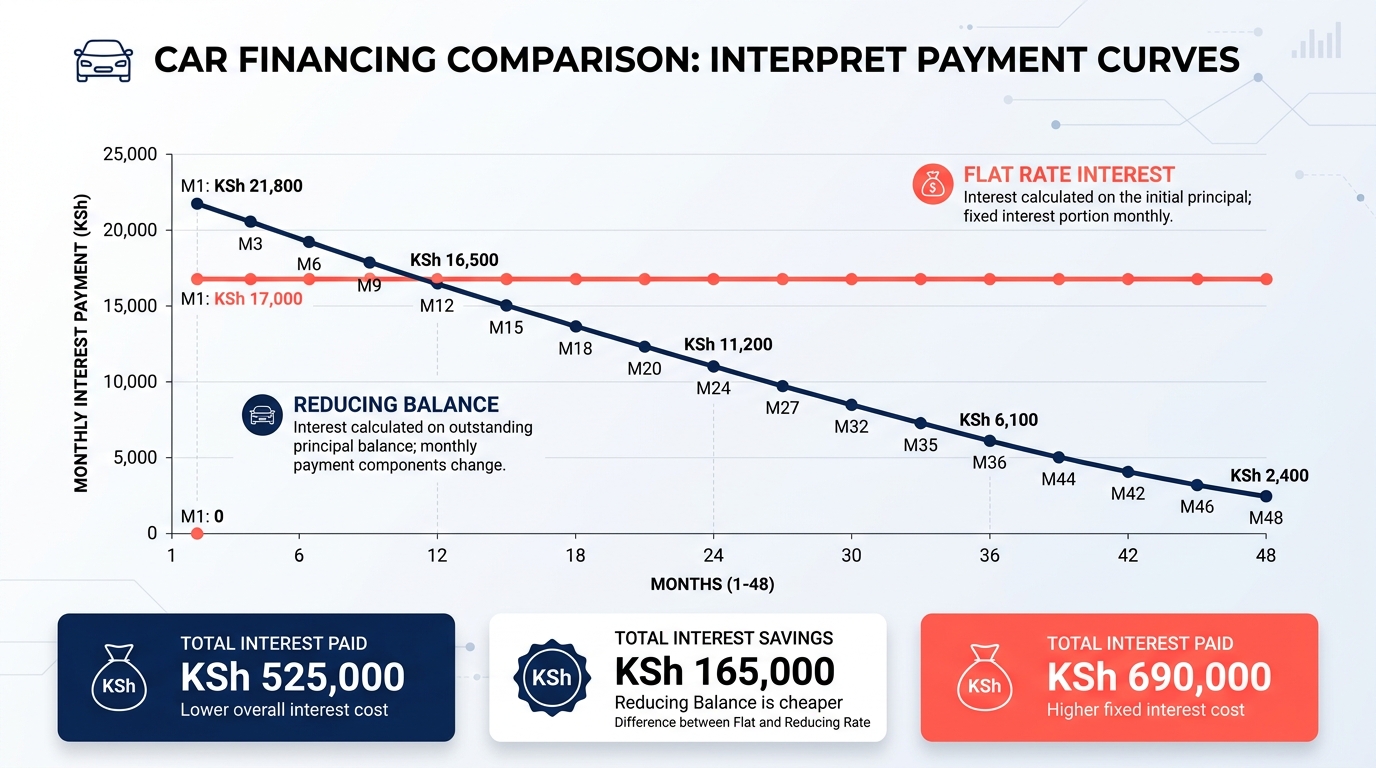
Worked Showroom Example: The KSh 1.5 Million Car
Suppose you are buying a used Toyota Fielder or Mazda Axio valued at KSh 1,500,000. You have saved a KSh 300,000 deposit (20%) and need to finance the remaining KSh 1,200,000 over 4 years (48 months).
Here is how the two paths compare side-by-side:
| Loan Parameter | Path A: Bank Asset Finance | Path B: Dealer Hire Purchase |
|---|---|---|
| Vehicle Valuation | KSh 1,500,000 | KSh 1,500,000 |
| Your Cash Deposit | KSh 300,000 (20%) | KSh 300,000 (20%) |
| Amount Financed | KSh 1,200,000 | KSh 1,200,000 |
| Quoted Interest Rate | ~17% Reducing Balance | "~10% Flat Rate" |
| True Effective Rate | ~17.0% Reducing | ~18.2% Reducing Equivalent |
| Estimated Monthly Payment | ≈ KSh 34,500 | ≈ KSh 36,900 |
| Total Interest Paid | Baseline | + KSh 115,000 – KSh 165,000 HIGHER |
| Vehicle Ownership | Yours from Day 1 (Lien) | Financier's (Until Month 48) |
The Bottom Line: On the exact same car, with the exact same deposit, the Hire Purchase agreement forces you to pay a higher monthly instalment *and* tens of thousands of shillings more in total interest—all while denying you legal ownership of the vehicle until the final payment clears.
*Tip: Use the calculator above to test your own price — try KSh 1.3M vs 1.5M and see the gap move. Also check How Custom Duty Is Calculated for Car Imports.*
Ownership Risk: Repossession Clauses Under Kenyan Law
Ownership is not a minor detail—it is the defining legal line between protection and vulnerability.
1. Under a Bank Loan: The car is legally yours. If you hit financial hardship and default, the bank can repossess and auction the vehicle to recover their outstanding debt. However, because you hold legal title, you are entitled to any surplus funds generated from the auction after the loan is cleared. Furthermore, you retain the legal right to sell the vehicle privately at market value to clear the bank balance early. See Understanding Car Insurance Underwriting rules for mandatory cover.
2. Under Hire Purchase: The financier owns the vehicle outright. You cannot sell, trade in, or modify the car without written consent.
If you fall behind on instalments, strict termination clauses under Cap 507 allow the financier to repossess the vehicle. High Court precedents in Kenya have upheld agreements where financiers repossessed cars without advance notice and without refunding previous monthly payments.
> ⚠️ Market Warning: Industry reports have highlighted predatory private Hire Purchase contracts in Kenya that peg interest rates to US Dollars, charge fixed interest on reducing balances, and trigger immediate repossession over minor payment delays—leaving borrowers owing money even after the car has been taken back. Always confirm currency: KES not USD. See Clearing Cars at Mombasa Port: Step by Step for port-related lien risks.
*Learn more: How to Avoid Logbook Scams in Kenya.*
The Showroom Decision Matrix
Which financing path fits your current situation? Use this breakdown to select the right approach:
- 1. Formal Salaried Employee (Payslips + Clean CRB): → BEST CHOICE: Bank Asset Finance — Why: Lowest total interest cost, immediate ownership, flexible repayment. See How to Secure Car Asset Financing in Kenya.
- 2. Business Owner / SME (Seeking Tax Efficiency): → BEST CHOICE: Hire Purchase — Why: Hire payments can be structured as tax-deductible operating expenses.
- 3. Informal Earner / Damaged CRB Rating: → BEST CHOICE: Hire Purchase — Why: Flexible vetting opens doors banks close—provided you audit the flat rate.
- 4. Long-Term Driver (Planning 5+ Years Use): → BEST CHOICE: Bank Asset Finance — Why: Lower total cost of credit + freedom to sell or refinance at any time.
> This matrix is a guide — always run your numbers through the calculator above and verify with your SACCO or bank.

The 6 Mandatory Showroom Safeguards
Before you sign any asset finance or hire purchase agreement in Kenya, insist on these 6 non-negotiable checks:
- Convert Flat Rates to Reducing Balance: Demand that the lender state the *effective annual reducing-balance interest rate (APR)*. A "10% flat" quote is never 10%.
- Demand the Total Cost of Credit (TCC) in Writing: Require an itemized schedule listing total interest, processing fees, negotiation fees, valuation costs, mandatory tracker fees, and early-settlement penalties.
- Inspect Default and Repossession Clauses: Verify what notice period is required before repossession occurs, and confirm what happens to your equity if the car is sold.
- Confirm the Currency: Ensure your interest rate and monthly instalments are fixed in Kenya Shillings (KES). If your rate is pegged to the USD while you earn KES, exchange rate fluctuations can destroy your budget.
- Factor in Comprehensive Insurance: Comprehensive insurance is mandatory for both options to protect the lender's collateral. Ensure this annual premium (typically 4%–5% of vehicle value) is budgeted.
- Evaluate SACCOs as a Regulated Alternative: Deposit-taking SACCOs regulated by SASRA offer some of the most competitive reducing-balance rates in Kenya (often 12%–14% p.a. on reducing balance). If you are a SACCO member, check their asset finance terms before signing.
*Also read: Demystifying QISJ & JEVIC Import Inspections and Evaluating Japanese Auction Sheet Grades.*
Frequently Asked Questions (FAQs)
Under the Hire Purchase Act (Cap 507), if you have paid less than two-thirds of the total hire purchase price, the financier can repossess the vehicle upon default according to the contract terms without requiring a court order.
For registered businesses and SMEs, hire purchase instalments can often be claimed as operating expenses, offering tax deduction benefits. Consult a certified Kenyan tax accountant for your specific business structure.
Under Kenyan banking regulations, paying off your bank asset finance loan early reduces your overall interest burden because interest is charged on a reducing balance. Check your offer letter for any nominal early settlement administration fees.
Always confirm the current requirements on the official NTSA portal before you pay anyone, and keep the payment receipt.
Claim Your Free Pre-Signing Financing Audit
Are you currently reviewing a financing proposal from a bank, SACCO, or Hire Purchase dealer? Don't sign blindly.
Bring your financing quote or offer letter to our team for a 100% Free Pre-Signing Audit. We will:
- Convert any quoted "flat rate" into its true reducing-balance equivalent.
- Calculate your exact Total Cost of Credit across the loan tenure.
- Identify hidden processing, valuation, or repossession clauses in the contract fine print.
👉 Get Your Financing Quote Audited on WhatsApp → +254 790 406903
P.S. (TL;DR): If you earn a formal salary and have clean bank statements, never accept a flat-rate Hire Purchase deal without comparing it to Bank Asset Finance. On a standard KSh 1.5M vehicle, opting for a bank loan saves you over KSh 165,000 in interest and grants you legal ownership of your car from day one.
Explore more: Vehicle Valuation and Loan Limits in Kenya • Navigating Kenya's 8-Year Car Age Limit Rule • How to Secure Car Asset Financing in Kenya.
Hire Purchase vs. Bank Loan — The Decision Matrix
A side-by-side comparison of the two ways to finance a car in Kenya, with the numbers that decide it.
What you will discover inside
- ✓How interest is calculated on each (reducing balance vs. flat HP)
- ✓The real cost difference on the same car over 36 months
- ✓What HP does to your title, and what that means for resale
- ✓Early settlement: what each lender charges
- ✓The point at which HP is the cheaper route, and the point at which it is not
Free Download: Hire Purchase vs. Bank Loan — The Decision Matrix
100% free. Delivered instantly to your email and WhatsApp.