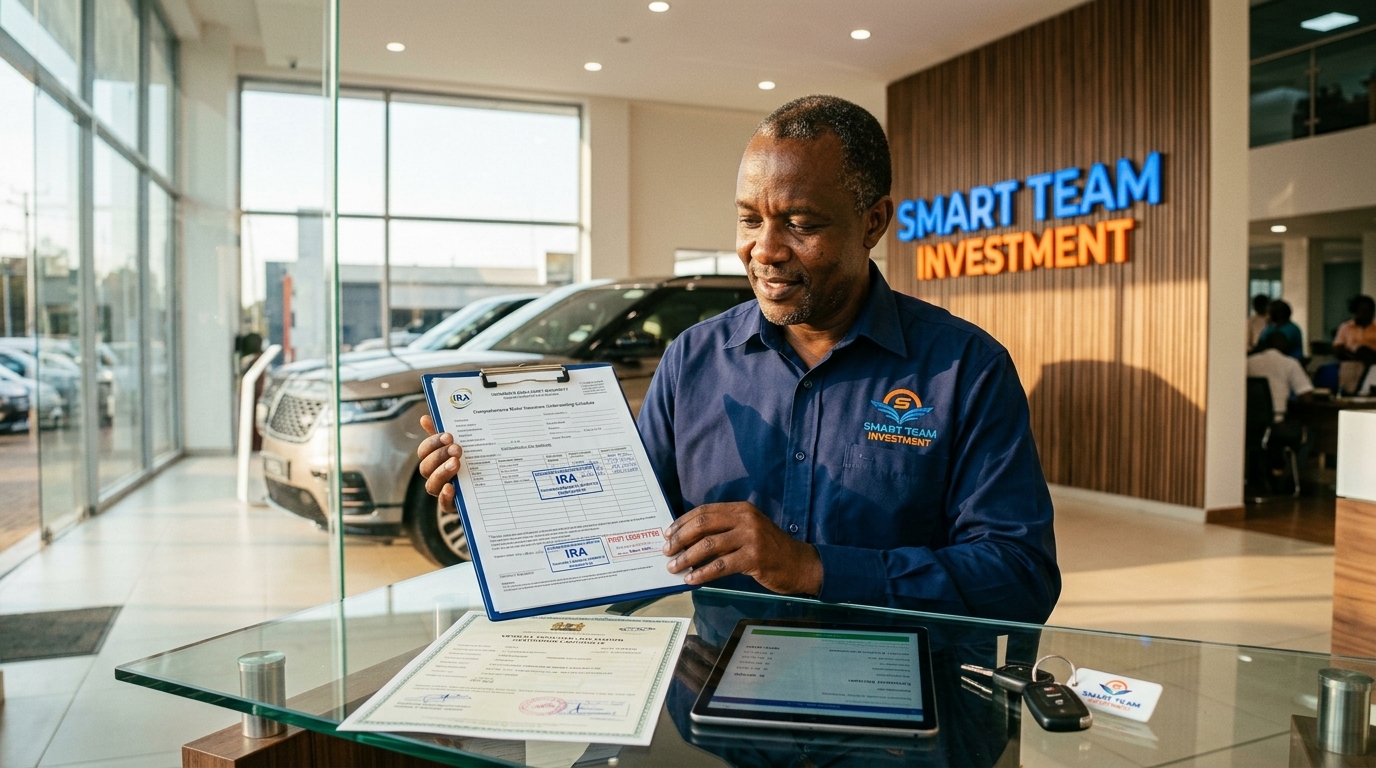
The 11 PM Accident Nightmare You Never Planned For
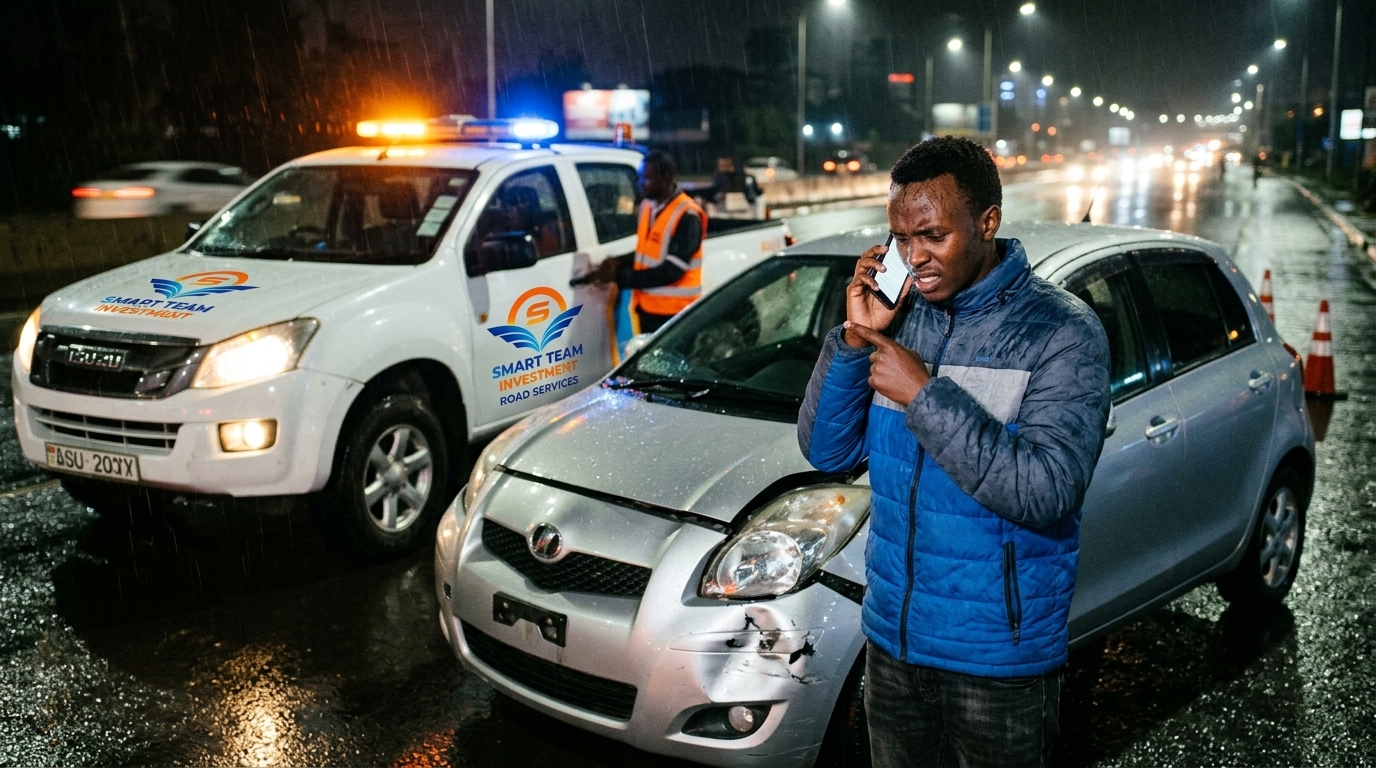
Picture this: It's 11:15 PM on a rainy Friday night along Mombasa Road. You're driving your newly acquired KSh 1,000,000 Toyota Vitz — the one you financed through a 48-month bank asset loan. Suddenly, a matatu stops abruptly in front of you. You slam on the brakes, but your tyres skid on the slick tarmac, crashing into its rear bumper.
Your bumper is crumpled, the radiator is smashed, and the matatu's rear door is caved in. Total damage: KSh 180,000.
You take a deep breath, pull out the crisp insurance cover note you bought through a local WhatsApp agent, and call the insurer's emergency line expecting full coverage.
Then the underwriter drops the hammer:
- Claim Rejected: Undisclosed Commercial Use. You occasionally turned on Bolt or Uber after work (trading on a "Private Car" policy) — your own-damage claim is void.
- Excess Mandatory Out-of-Pocket: KSh 35,000. You were hit with the KSh 7,500 third-party excess, a KSh 5,000 young/novice driver penalty, and a 2.5% loss excess you never knew existed.
- Policy Void: Unapproved Valuer. Your sum insured wasn't locked by an IRA-approved valuer.
In 30 seconds, your KSh 1,000,000 dream turns into a KSh 180,000 cash debt, while your bank threatens to cancel your loan because the collateral is uninsured.
What an Insurance Underwriter Actually Does in Kenya
An underwriter is the invisible financial gatekeeper standing between your wallet and the insurance company. Before any Kenyan insurer issues a policy, the underwriter evaluates your risk by asking two binary questions:
- Will we accept this risk at all? High-risk vehicles, unapproved drivers, or commercial uses get declined outright.
- If yes, at what price, with what conditions, and what mandatory excesses?
Underwriting in Kenya is governed strictly by the Insurance Act (Cap. 487) and the Insurance (Motor Vehicle Third Party Risks) Act (Cap. 405), enforced by the Insurance Regulatory Authority (IRA), alongside the Insurance (Products) Regulations, 2025 and Legal Notice 55 of 2026.
Run the premium and excess math on your own car below:
Kenyan Car Insurance & Excess Calculator
Underwriting premium stack + mandatory out-of-pocket excess risk (2026)
Basic Premium (4%)
KSh 42,500
Statutory Levies
KSh 191 + KSh 40
AA Road Rescue
KSh 6,500
Courtesy Car
KSh 8,100
TOTAL ANNUAL PREMIUM
KSh 57,331
GREEN — POLICY STRUCTURED CORRECTLY
Private use with comprehensive cover and no young-driver penalty. Expect KSh 27,500 out-of-pocket (third-party excess + own-damage excess) before the insurer settles your claim.
Own-Damage Excess (2.5%)
KSh 20,000
Third-Party Property Excess
KSh 7,500
Young / Novice Penalty
KSh 0
Verify your cover note via IRA DMVIC USSD *352# before paying a premium. Keep at least KSh 20,000 liquid to cover mandatory excesses, and lock your sum insured with an IRA-approved valuer.
>> Slide your Open Market Value, select vehicle use, driver age and licence experience to compute your annual comprehensive premium stack and mandatory out-of-pocket excess risk.
Part 1: The 3 Cover Tiers (And What the Law Forces You to Buy)
Kenyan motor insurance is split into three distinct tiers. Understanding these tiers is essential when buying or financing a vehicle in Kenya:
| Feature | Third Party Only (TPO) | Third Party Fire & Theft (TPFT) | Comprehensive Cover |
|---|---|---|---|
| Damage to Other Vehicles / Persons | Covered | Covered | Covered |
| Your Vehicle — Fire Damage | Zero | Covered | Covered |
| Your Vehicle — Theft / Hijacking | Zero | Covered | Covered |
| Your Vehicle — Accident, Flood, Vandalism | Zero | Zero | Fully Covered |
| Is It Legally Mandatory? | YES (Cap. 405 Floor) | Optional | Optional (Mandatory for Bank Loans) |
| Typical 2026 Pricing | Flat ~KSh 7,500/yr + levies | ~2.125% of car value | ~3.5% – 4.25% of car value |
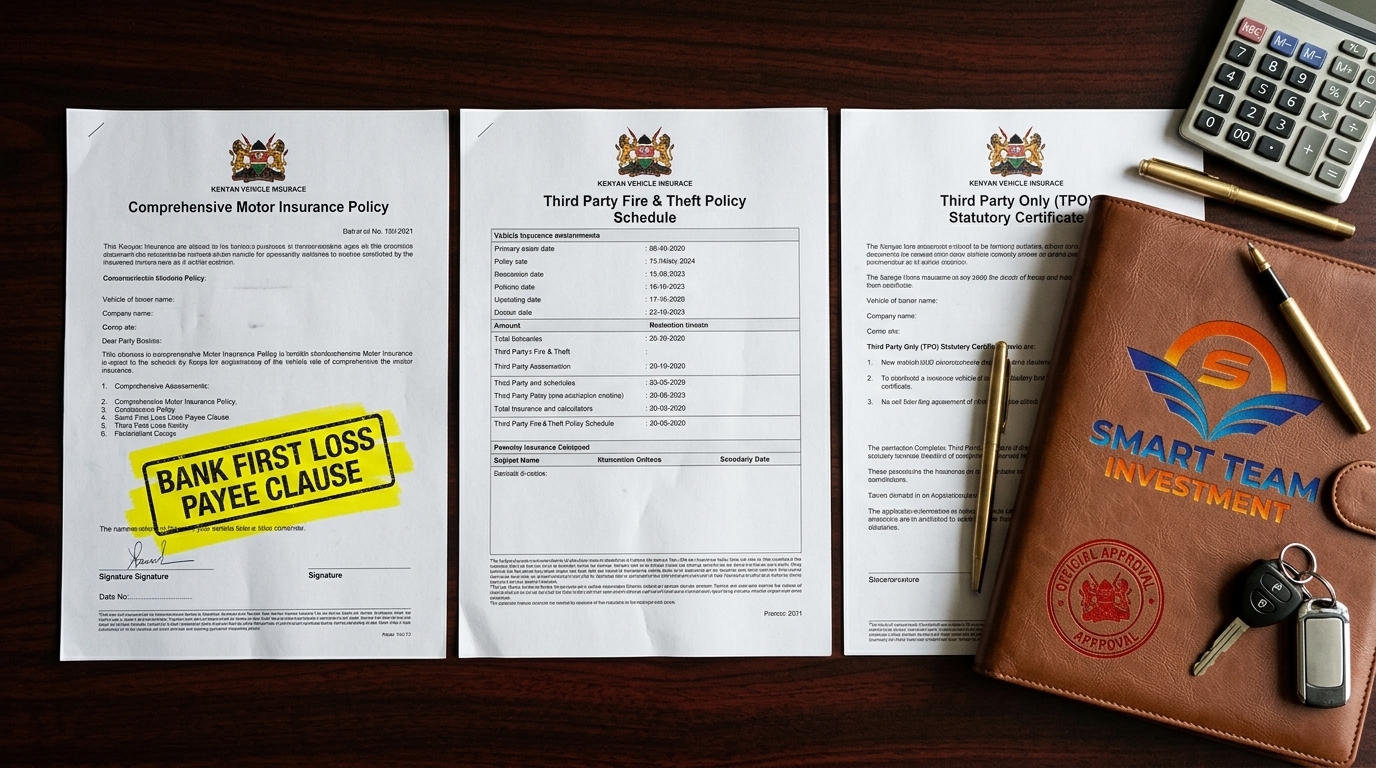
The Financed Car Warning: If you bought your car via Bank Asset Finance or Hire Purchase, your loan agreement legally mandates Comprehensive Insurance with the bank listed as the First Loss Payee. Buying a TPO sticker to "save money" violates your bank contract, leading to immediate loan recall or forced bank-placed insurance at twice the market rate. See our Hire Purchase vs Bank Loans guide and Car Asset Financing guide.
Part 2: The Underwriting Pricing Formula (How Your KSh 49,300 Bill is Calculated)
Insurers do not guess premiums. Your comprehensive rate is built from an exact mathematical stack applied to the Sum Insured established by an official valuation report from AA Kenya, Regent, or Avenue Valuers:
Worked Example: KSh 1,000,000 Private Car (Sanlam / Standard Chartered Rates)
| Premium Line Item | Amount |
|---|---|
| Basic Premium (4.25% of KSh 1,000,000 Sum Insured) | KSh 42,500 |
| Statutory Levies (0.45% Training & PHCF Levy) | KSh 191 |
| Stamp Duty | KSh 40 |
| AA Kenya Road Rescue Fee | KSh 6,500 |
| Courtesy Car Benefit (Optional 10-day replacement) | KSh 8,100 |
| TOTAL ANNUAL PREMIUM OUTFLOW | ~KSh 49,300/yr |
The 5 Underwriting Knobs That Shift Your Price
- Sum Insured (Vehicle Value): The anchor of every calculation. Above KSh 2.5M, basic rates drop from 4.25% to 3.5%.
- Vehicle Class & Engine Size: Commercial pickups, 14-seater matatus, and high-cc performance engines carry higher risk brackets than 1.0L–1.5L compacts.
- Vehicle Use (Private vs. Commercial/PSV): The single biggest price lever — and the #1 cause of rejected claims in Kenya.
- Driver Age & Experience: Drivers under 25 or holding a license for under 2 years incur a mandatory KSh 5,000 Young/Novice Driver Excess.
- No-Claims Discount (NCD): Claim-free years reduce basic rates, but claiming cancels your NCD, requiring a reinstatement fee (~0.25% of vehicle value, min KSh 2,000).
Part 3: The 5 Fine-Print Rules That Void Your Claim Instantly
Kenyan courts consistently enforce underwriting terms against policyholders. Here are the top 5 traps that leave buyers stranded:
[Private Policy + Uber/Bolt] ➔ [Claim Rejected Under Utmost Good Faith] [Lapsed Premium Payment] ➔ [Zero Coverage at Crash Scene] [Unapproved Valuer Report] ➔ [Sum Insured Disputed at Settlement] [Fake Agent Sticker] ➔ [No Record on IRA DMVIC System (*352#)] [Ignoring Excess Schedule] ➔ [Unexpected KSh 15k–30k Out-of-Pocket Outflow]
- Undisclosed Ride-Hailing Use: Section 10 of Cap. 405 protects third parties you hit, but it does NOT protect your own car. In *Insurance Ltd v Benjamin Ndolo Kimote [2020] eKLR*, Kenyan courts ruled that using a private-insured car for commercial taxi work voids comprehensive payout to the owner.
- Material Non-Disclosure: Falsifying driver age, misrepresenting vehicle usage, or hiding previous accident history constitutes fraud, voiding the policy *ab initio*.
- Lapsed Installment Payments: Insurance Premium Financing (IPF) allows you to spread insurance over 10 months. Missing a single IPF payment cancels the cover note immediately.
- Hidden Policy Excesses: You must pay mandatory out-of-pocket excesses before the insurer pays a shilling:
- Under-Insuring vs. Over-Insuring: Declaring a KSh 1.2M car as KSh 800,000 applies the Average Clause (the insurer pays only 66% of any damage claim). Declaring it as KSh 1.8M wastes premium because payouts are capped at current Open Market Value (OMV).
Part 4: The 2026 Fraud Crackdown & How to Protect Yourself
Fake insurance stickers are a major crisis in Kenya. In 2026, IRA and the Insurance Fraud Investigation Unit (IFIU) launched major highway drives arresting drivers with counterfeit certificates. Furthermore, in March 2026, the IRA placed Trident Insurance, KUSCCO Mutual, and Corporate Insurance under statutory management, barring them from issuing policies due to unpaid claims.
The 3-Step Verification Protocol Before You Pay
- Verify Official Licensing: Check that your underwriter is active on IRA's official licensed entity list.
- Demand Digital DMVIC Certificates: Ensure your provider issues an instant Digital Motor Vehicle Insurance Certificate (DMVIC) generated directly through IRA's digital system.
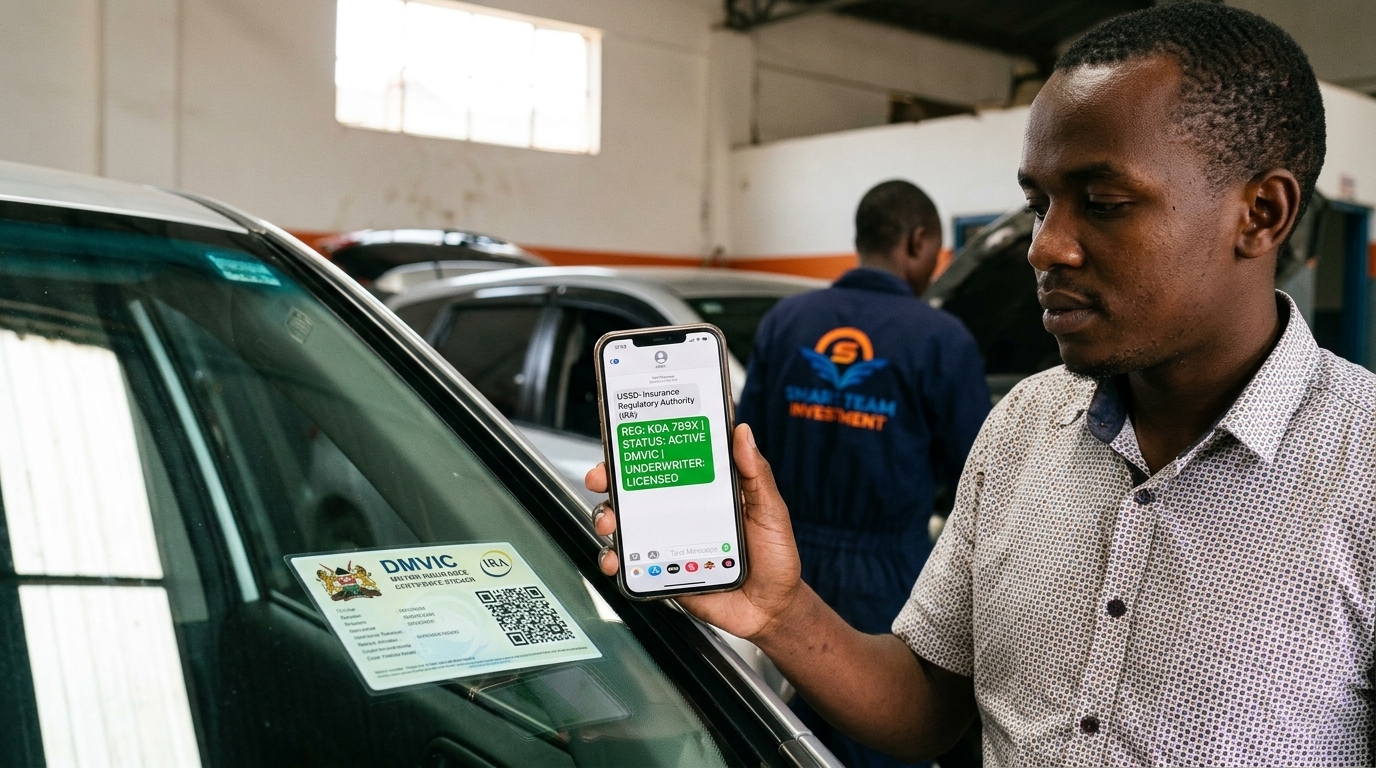
- Run the USSD Verification Code: Type *352# on your mobile phone, enter your vehicle registration number, and confirm instantly that your policy is active on IRA servers.
Frequently Asked Questions (Voices & Long-Tail Intent)
If you get involved in an accident while running ride-hailing apps under a 'Private' car policy, the underwriter will reject your Own Damage claim under the doctrine of Utmost Good Faith (Uberrimae Fidei). While third-party liability is covered under Cap. 405, your own vehicle's repairs will come 100% out of pocket. Always request a Commercial PSV / Ride-Hailing endorsement if you run Uber or Bolt.
Dial *352# on your mobile phone, enter your vehicle registration number, and the IRA DMVIC system will instantly reply via SMS with your active policy details, insurer name, and expiry date. Never trust a paper sticker without running this USSD verification first.
Comprehensive cover is priced as a percentage of your insured value (Sum Insured), plus percentage levies, stamp duty and any benefits you add on. Private comprehensive in Kenya commonly sits in a 3%–7.5% band depending on the car, the driver and the insurer’s minimum premium, so treat any single percentage as indicative. On a KSh 1,000,000 car at 4.25%, the core premium is about KSh 42,500, plus KSh 191 in levies, KSh 40 stamp duty and a road-rescue fee — roughly KSh 49,200. Add around KSh 8,100 more if you take the optional courtesy car. There is no published rate card: get a written quote.
The Average Clause applies when you under-insure your vehicle. If your car's true Open Market Value (OMV) is KSh 1,200,000 but you insure it for KSh 800,000 (66% of its value), the insurer will only pay 66% of any partial repair claim, leaving you to pay the remaining 34% out of pocket.
You pay out-of-pocket before the insurer pays a shilling: third-party property excess of about KSh 7,500, own-damage excess of 2.5% of claim value (min KSh 15,000), a KSh 5,000 young/novice driver penalty if you are under 25 or licensed under 2 years, and a loss-of-use time excess excluding the first 3 days.
Always confirm the current requirements on the official NTSA portal before you pay anyone, and keep the payment receipt.
Godfather Offer: Free 1-on-1 WhatsApp Insurance & Policy Underwriting Audit
Before you sign an insurance proposal or transfer cash to a broker, let our automotive due-diligence team verify your policy risk-free.
What You Get in Your Free Audit (100% FREE - Valued at KSh 15,000):
- CRSP & OMV Sum Insured Check: We lock the exact valuation figure so you never overpay premium or trigger the Average Clause.
- Underwriting Policy & Excess Audit: We review the fine print to catch hidden young-driver penalties, ride-hailing exclusions, and excess traps.
- **IRA DMVIC & *352# Status Verification:** We verify that your cover note is 100% genuine and registered with IRA.
📲 Claim Your Free Insurance Audit on WhatsApp: Send "INSURANCE AUDIT" or your quote/cover note screenshot to +254 790 406903.
Summary Checklist (TL;DR)
- Match Policy to Use: Private means private. If you run Uber/Bolt, get commercial PSV cover.
- Financed Cars Need Comprehensive: Bank asset loans require comprehensive cover with the lender named as First Loss Payee.
- Budget for Excesses: Always hold KSh 20,000 in cash reserve to cover mandatory claim excesses.
- **Verify via *352#:** Never trust a paper sticker without running IRA's *352# USSD check.
- Lock Sum Insured via Approved Valuers: Ensure your sum insured matches an official OMV report from AA Kenya, Regent, or Avenue Valuers.
Kenyan Car Insurance & Excess Calculator
Underwriting premium stack + mandatory out-of-pocket excess risk (2026)
Basic Premium (4%)
KSh 42,500
Statutory Levies
KSh 191 + KSh 40
AA Road Rescue
KSh 6,500
Courtesy Car
KSh 8,100
TOTAL ANNUAL PREMIUM
KSh 57,331
GREEN — POLICY STRUCTURED CORRECTLY
Private use with comprehensive cover and no young-driver penalty. Expect KSh 27,500 out-of-pocket (third-party excess + own-damage excess) before the insurer settles your claim.
Own-Damage Excess (2.5%)
KSh 20,000
Third-Party Property Excess
KSh 7,500
Young / Novice Penalty
KSh 0
Verify your cover note via IRA DMVIC USSD *352# before paying a premium. Keep at least KSh 20,000 liquid to cover mandatory excesses, and lock your sum insured with an IRA-approved valuer.
The Car Insurance Underwriting Red Flags Guide
How insurers price and underwrite a Kenyan car policy — and the clauses that decide what you actually get paid.
What you will discover inside
- ✓The average clause and how under-insurance cuts your payout
- ✓The excesses you pay before the insurer pays anything
- ✓How to verify a policy is real using the *352# check
- ✓Private vs. commercial cover if you drive for Uber or Bolt
- ✓The valuation inputs and the documentation to keep at claim time
Free Download: The Car Insurance Underwriting Red Flags Guide
100% free. Delivered instantly to your email and WhatsApp.