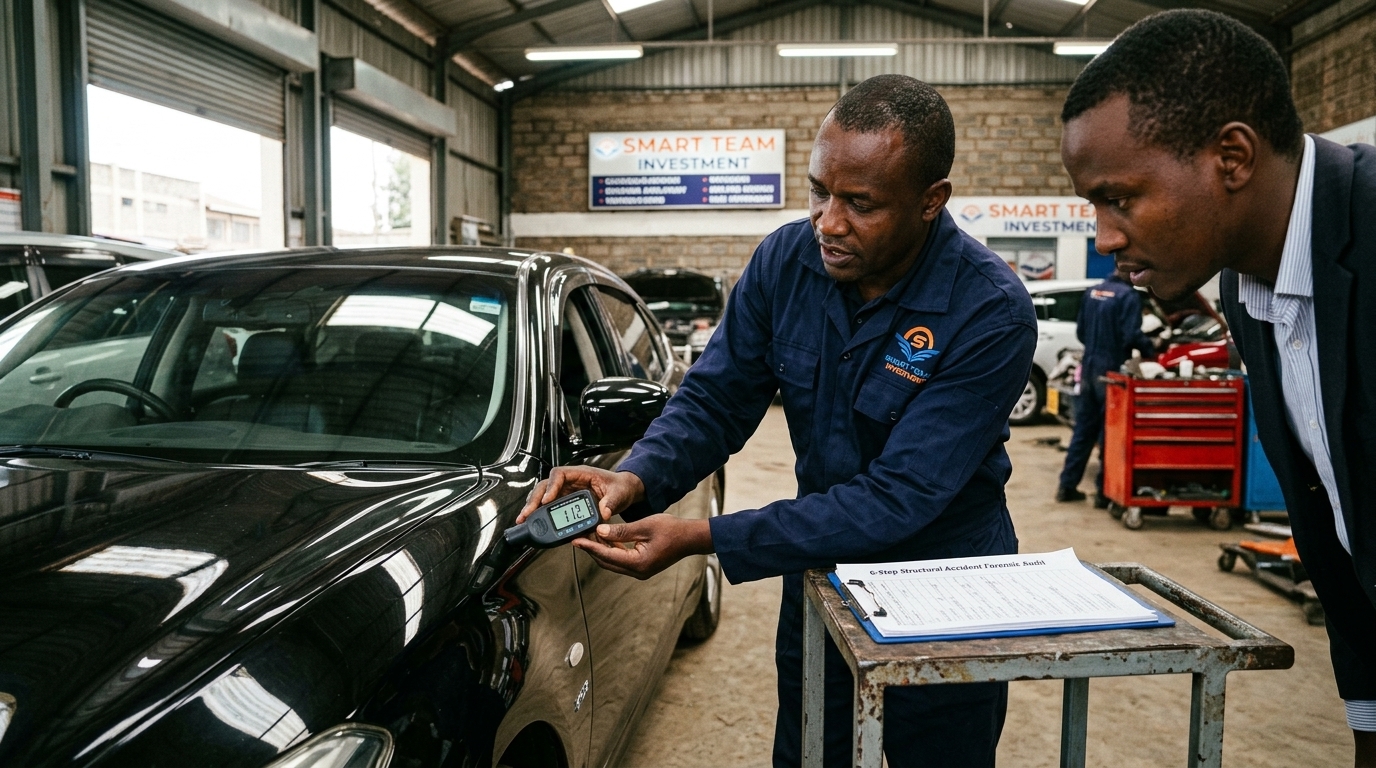
The 'Cut-and-Shut' Car That Looked Brand-New
> Direct Answer (AI Overview Summary): You can tell if a used car has been in an accident with a 6-step body-language inspection: (1) a magnet-and-paint test for filler, (2) panel gaps and door-fight alignment, (3) engine-bay spot welds and rail straightness, (4) glass date-code stamps, (5) airbag and seatbelt telltales, and (6) a hoist underbody check plus calm test drive. Score every step honestly and a truly structural repair rarely survives all six.
Brian earns a gross KSh 150,000 a month. After months of saving, he finally stood at a Nairobi yard staring at what he thought was his dream: a 2016 Toyota Corolla Fielder, KSh 1,380,000, pearl-white paint, 62,000 km, and a seller who swore it was a *"Japanese one-owner, straight from the port, hakuna accident at all."*
Brian walked around it slowly. The paint was flawless under the showroom LED lights. He opened the bonnet. It looked clean. He test-drove it — smooth. He paid, signed, and drove home glowing.
Six months later he almost lost his life. A light rear-end tap at a traffic light in Westlands — nothing more than a fender bump — and the Corolla's rear crumpled like tinfoil. When the insurance assessor looked under the boot carpet, he found it: the car had been in a severe rear collision, cut away, and a fresh "tail" section welded back on. The bumper mount bolts were hand-cut, the rear rail was a patch-welded splice, and the whole rear quarter had been rebuilt with bondo. The fresh paint had been hiding a structural repair that turned a survivable fender tap into a near-fatality.
Brian's "Japanese one-owner" was a cut-and-shut rebuild that had been exported, imported, and polished to look innocent.
That is the reality of accident cars in Kenya. And it is exactly why this guide exists — by the time you finish Step 6, you will spot Brian's car in ten minutes, not six months.
Step 1: The Magnet & Paint Check (The Bondo Test)
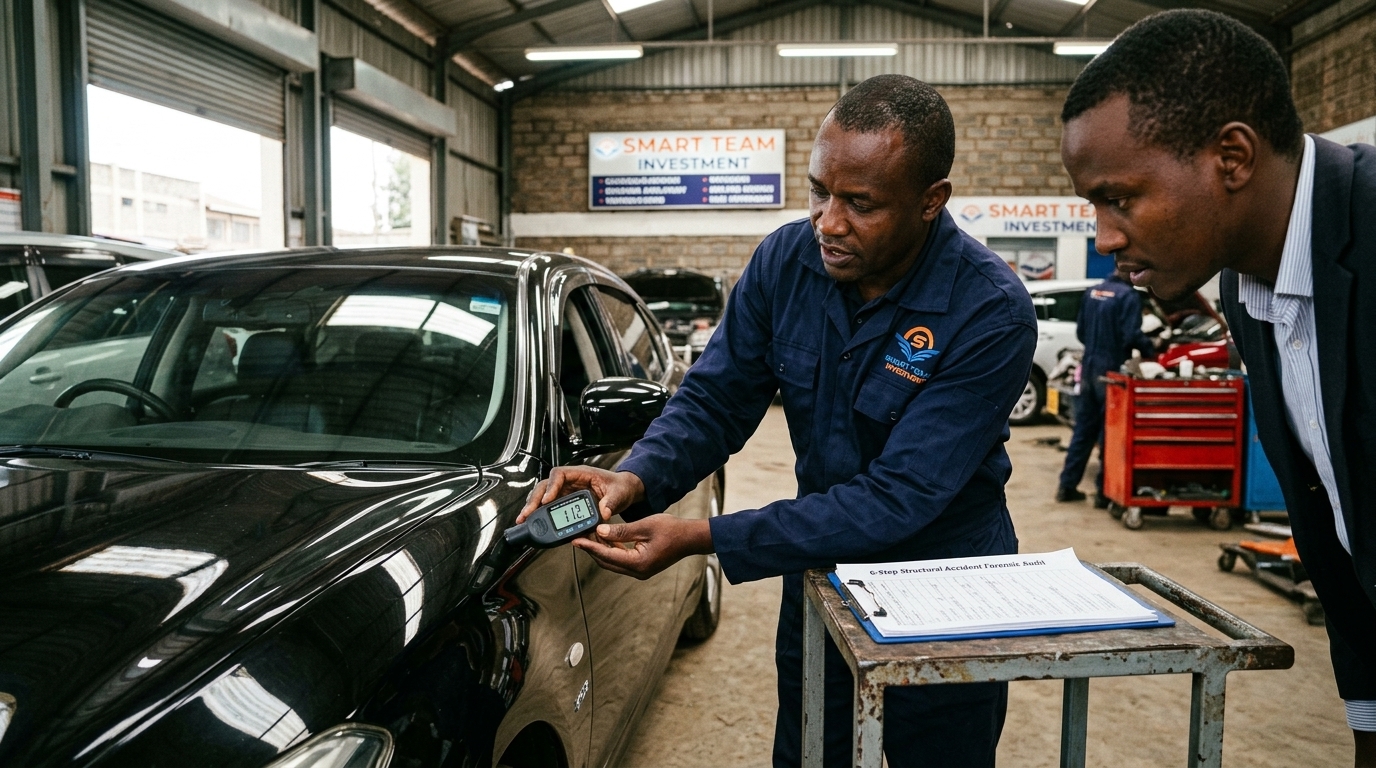
A body that has been repaired with filler loses its magnetic grip. A serious accident pushes steel into wrinkles; panel beaters fill the wrinkles with a thick, spreadable compound called bondo (body filler) before repainting. Bondo is not steel — and a magnet notices.
Every Kenyan inspector should carry a small round magnet (about KSh 50) covered in a thin cloth so it slides without scratching.
How to run the test:
1. Slide the wrapped magnet slowly over every panel — bonnet, fenders, doors, boot, roof, and especially the sills and wheel arches. 2. Feel for grip. The magnet should pull evenly across the whole panel — like it does on a fridge. 3. Mark any spot where the magnet weakens or drops off. That is 2mm+ of filler standing between you and the original steel. 4. Use a phone flashlight at a grazing angle. Filler sanded and polished shows a slightly duller, wavier sheen than factory paint. 5. Heavy rust pimples or cracks in the paint over a panel usually mean the filler has absorbed water and started to push out.
A small spot on a bumper is cosmetic. Filler on a structural panel — the door opening frame, the sill, the A-pillar, the quarter panel — is danger. That is where impact energy crumpled the steel and the "repair" was to hide it.
> 💡 Related Reading: Before you trust even a clean magnet result, run the full mechanical gauntlet in Top 5 Mechanical Points to Check on Kenyan Roads and confirm the history documents in How to Avoid Logbook Scams in Kenya (2026).
Step 2: Panel Gaps & the Door 'Fight' Test
Factory-built panels leave uniform, consistent gaps — 3 to 4 mm around every door, the bonnet, and the boot. Humans repairing accident damage leave gaps the width of a credit card on one side and a knife-edge on the other.
Three quick tells at the yard:
1. The credit-card trick. Slide a bank card into the gap between the bonnet and fender at the top, middle, and bottom. A factory car feels even pressure all the way down. A repaired car bites the card in some spots and swallows it in others. 2. The door-fight test. Open and close every door, the bonnet, and the boot slowly. A factory door closes with a soft thud and even latch engagement. A door that needs a hard slam, catches, or sits proud of the body line means the hinge pillar or frame moved in an accident. 3. The shine-down-the-side check. Kneel at one end of the car and look down each flank at eye level. The door lines and panel creases should run perfectly straight. Wavy reflections on a panel scream filler.
A panel that is a different shade — the classic "one door looks slightly newer" — means that panel was replaced after an accident, and replacement panels almost always need paint to match.
> 💡 Related Reading: For the paper trail behind those badges and stickers, decode the export record in Evaluating Japanese Auction Sheet Grades & Panel Codes — the auction sheet rewards honest buyers and buries dishonest ones.
Step 3: Engine Bay, Spot Welds & Strut Towers
This is where body shops get lazy, because buyers rarely open the bonnet for more than ten seconds.
Japanese factories build the front chassis with uniform rows of factory spot welds — small, round, evenly spaced dimples along the rails, the radiator support, and the bulkhead. Panel beaters join steel with long MIG hand-weld beads that look like a worm crawling along the metal.
What to check under the bonnet:
1. Spot-weld rows. Factory cars show neat spaced dimples; repaired cars show continuous weld beads or ground-off splashes. 2. Strut towers (the tops of the front suspension mounts). Look at both towers. They should be identical, round, and unpainted steel grey. A collapsed or hammered tower, fresh white paint over one tower, or a tower that sits slightly lower than its twin is a major front-hit signal. 3. The radiator support. Wrinkled, re-drilled, or MIG-welded radiator supports are almost always accident damage. 4. The crossmember and chassis rails. Look under the front bumper area for creased, patched, or freshly painted rails. Take a photo and compare left to right — symmetry is your friend. 5. Fresh paint that does not belong. Engine bays are never repainted on a health car. Fresh paint on the bay walls or inner fenders means the sheet metal there was repaired.
Step 4: Glass Stamps & Date Codes (The Silent Witnesses)
Car glass is date-stamped at the factory, and it almost never lies.
On Japanese cars the etch code on the bottom corner of each window holds the build date. The last digit gives the year (e.g., a final 6 on a 2016 Corolla build). The dot(s) ahead of it indicate the month. So a window reading · 6 or ·· 6 belongs to a 2016 build — exactly what a 2016 car should wear.
The inspection logic is dead simple:
1. Compare every window. All glass on an original car shares a date close to the year of build. Read the rear windows, rear quarter-lights, and the windshield. 2. One newer windshield usually means a stone-chip replacement — minor and common on Kenyan roads. 3. Two or more mismatched windows — say a series of 2019-etched windows in a 2016 car — mean multiple panels took glass-breaking impacts, or the glass was broken during theft/break-in. 4. A fresh windshield in a car with repainted pillars is the collision red-flag combo. The pillar paint got damaged in the roof/front hit alongside the glass.
> 💡 Related Reading: Where the paper trail on a damaged import hides most often is the export sheet — see Demystifying QISJ & JEVIC Import Inspections to know what after-arrival inspections really do and do not catch.
Step 5: Airbag & Seatbelt Telltales (The Deployment Scam)
When a car hits hard enough to flatten a quarter panel, the airbags usually deploy. Rebuilding a crashed car on a budget skips the airbags — the cheapest "fix" in the Kenyan trade is to repack the steering wheel or replace the light bulb so the SRS light never shows.
Five airbag and belt tells:
1. The SRS light test. Turn the key to ON (don't start). The SRS warning should light up for 3–5 seconds, then switch off. If it never lights, the bulb was likely removed to hide a deployed airbag. If it stays on, the airbag circuit has a live fault. 2. The steering wheel pad. A deployed-and-repacked pad feels sunken, lumpy, or slightly irregular, and the factory stitching looks disturbed. 3. A mismatched cover. The airbag cover on the wheel should match the wheel's colour and wear. A cover that is a different shade or gloss is replacement after deployment. 4. Fresh seatbelts. Deployed belts are replaced. If the seatbelts look brand-new — zero fray, crisp labels — while the rest of the interior is 10 years old, ask why. 5. The passenger airbag seam. Look at the dashboard seam lines above the glovebox. After deployment the dash must be re-covered; imperfect seams, visible glue, or a wave in the dash top mean the airbag blew.
A deployed airbag is proof of a serious impact regardless of what the paint shows. It is a strong, honest signal — and most rebuilt cars fail this step.

Step 6: The Hoist Check & Calm Test Drive
The last two moves separate an amateur inspection from a professional one:
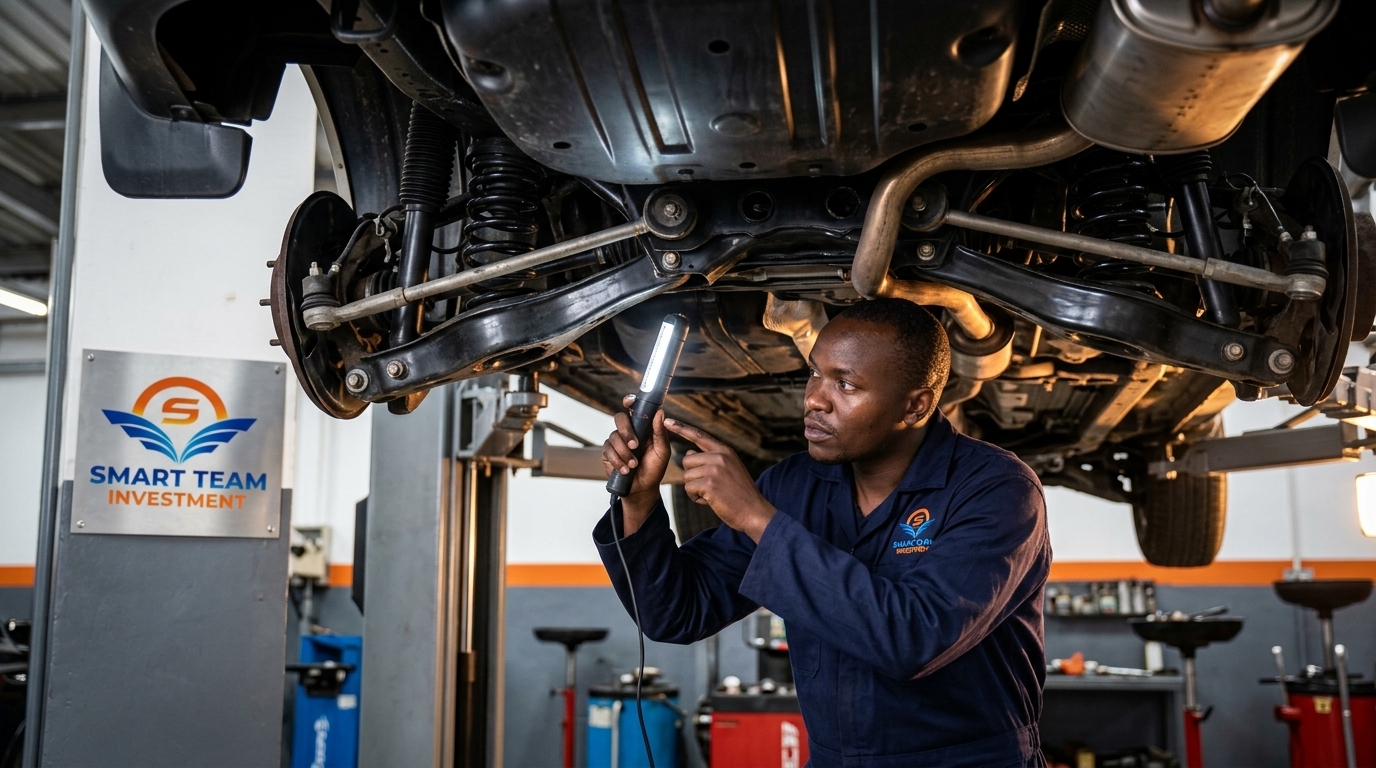
On the hoist (underbody): If the seller refuses to put the car on a hoist, walk away — that refusal is a tell by itself. Underneath, check:
* Chassis rails for creases, patch welds, or fresh paint running along the frame. * The floor pan for ripples or hammer marks that mean the floor was pulled back into shape. * Fresh underseal that is darker and softer than the rest — it is hiding previous damage. * Crossmembers and mounting points for elongated bolt holes that were re-drilled to shift a knocked-out subframe.
On the road: On a flat, calm road, gently release the steering wheel for 3–5 seconds at 60 km/h:
1. The car should track straight, not tug left or right (that can mean a bent rail or knocked-out geometry). 2. No pull under light braking and no vibration through the wheel (that can mean a bent hub or rim from a hard impact). 3. No constant drone or groan that gets worse on one side (that can mean a damaged wheel bearing after a curb or accident hit). 4. No creaks from the roof or pillars over a speed bump (that can be a repaired roof, which is a serious structural cut-and-shut sign).
A car that passes the hoist and tracks straight stone-cold, but still shows filler and weld evidence from earlier steps, is likely a repaired-but-usable car — buy it only at a structural discount.
> 💡 Related Reading: If the car's history leads you to a seller who is not the registered owner, run How to Buy a Car from a Kenyan Broker Without Getting Scammed before you negotiate a shilling.
Interactive Tool: Used Car Accident & Chassis Verification Calculator
Used Car Accident & Chassis Verification Calculator
Run the 7-point body-language checklist to compute the Structural Collision Risk Score (%) and the resale loss hidden in the asking price
1. Paint & Magnet (bondo test)
2. Panel Gaps & Door Alignment
3. Engine Bay & Spot Welds
4. Glass Date Codes (etch codes)
5. Airbag & Seatbelt Telltales
6. Underbody & Frame Rails
7. Auction Sheet History (if provided)
Select a result for all 7 checks (0/7 done) to compute your Structural Collision Risk Score. Find it honestly — the car you save may be future you.
This calculator weighs book evidence, not certainty. A clean score still deserves a neutral inspection report (QISJ, JEVIC, or an engineer) before you commit. Want a second set of eyes on your target car? Send "ACCIDENT AUDIT" with the listing link, chassis number, or photos to +254 790 406903 on WhatsApp.
Used Car Accident & Chassis Verification Calculator
Run the 7-point body-language checklist to compute the Structural Collision Risk Score (%) and the resale loss hidden in the asking price
1. Paint & Magnet (bondo test)
2. Panel Gaps & Door Alignment
3. Engine Bay & Spot Welds
4. Glass Date Codes (etch codes)
5. Airbag & Seatbelt Telltales
6. Underbody & Frame Rails
7. Auction Sheet History (if provided)
Select a result for all 7 checks (0/7 done) to compute your Structural Collision Risk Score. Find it honestly — the car you save may be future you.
This calculator weighs book evidence, not certainty. A clean score still deserves a neutral inspection report (QISJ, JEVIC, or an engineer) before you commit. Want a second set of eyes on your target car? Send "ACCIDENT AUDIT" with the listing link, chassis number, or photos to +254 790 406903 on WhatsApp.
The score weights structural evidence most heavily — weld beads, frame damage, and airbag deployment outrank cosmetic paint issues, because those are what decide whether a car is safe or a cut-and-shut. Answer honestly; the car you save may be future you.
What Your Japanese Auction Sheet Really Says About That Accident
The single most powerful document for accident detection is the Japanese export auction sheet, and most Kenyan buyers never see it because it looks like a wall of Japanese characters.
Key columns that expose accident history:
| Sheet Column | What It Means | Why It Matters for Accident Buyers |
|---|---|---|
| Grade (e.g., 4, 4.5, R) | The auction house's overall condition score | Grade R (Repair) = the car already went through structural repair in Japan after a collision |
| W1 / W2 / W3 | Repair marks — that panel was repaired before auction. W1 subtle, W2 visible, W3 major. | The single most useful code for accident buyers: a car graded 4.5 can still carry W2 marks. |
| XX | Panel replaced (or cut-and-joined, if on a pillar or core support). | Read where the XX sits — a front wing is bodywork, a B-pillar is not. |
| ★ / ★★ / ★★★ | Mileage doubt beside the odometer. | Not a panel mark. ★★★ means the inspector strongly suspects a rollback. |
| Repair / 修復 stamps | 'Repaired' stamps in the damage area boxes | The auction house openly noting repaired and refinished parts |
| 部品取り (Parts-car) | Sold as a donor/parts vehicle | The vehicle was too damaged to sell whole — a definitive walk-away signal |
| Mileage (走行距離) | Odometer reading at auction in Japan | Cross-check against the cluster; a mismatch means a rolled-back odometer hiding a 100k+ accident car |
A car exported to Kenya as Grade R is a cash-for-repair special. It is not automatically undriveable — light front repairs happen — but the correct response is: inspect the rails and welds on a hoist, expect hidden damage, and price it 30–50% below a clean-sheet car. A dealer who hands you a Grade R sheet and still asks clean-car money is testing you. Walk to the next lot.
> 💡 Related Reading: Decode every column properly in Evaluating Japanese Auction Sheet Grades & Panel Codes and verify the import paperwork in Demystifying QISJ & JEVIC Import Inspections.
Frequently Asked Questions (Accident Detection in Kenya)
Use the two-signal test before anything else. First, run a small round magnet (wrapped in a soft cloth) slowly over every panel — it should grip consistently. It thins or falls off in a patch, the panel carries 2mm+ of body filler (bondo). Second, look for the dealer's masking tell: overspray on rubber seals, door shuts, and plastic trim, plus a dull, sanded-off finish that just misses the edges of a panel. A full respray alone is cosmetic and most buyers price it in; a respray that is hiding a realigned panel is a structural problem, and that is the one that moves the price — a lot. Ask what was behind the paint rather than arguing about the discount.
R records that repair history was declared, and it is not a condition score. R is significant, RA lighter, and R1/R2/RB/RC also appear. R is not only collisions: flood damage, fire-extinguisher damage and cars modified so illegally they could not be driven in Japan are also graded R, so read the inspector notes to find out which you are looking at. Get the car on a hoist and check the strut towers and rails for weld beads and crumple zones pulled back into shape, then price the structural work accordingly. Two things people get wrong: a grade is **not** a KEBS bar — conformity is judged on the car's actual roadworthiness — and the marks that matter most (冠水 flood, 骨格修正 frame correction) appear only in the handwritten notes, never in the damage grid.
Three tells. One: the SRS light on the cluster should illuminate for 3–5 seconds on key-on, then switch off — if it never lights, the bulb has been pulled to hide a fault. Two: a deployed-then-repaired airbag leaves a sunken or lumpy steering-wheel pad, mismatched cover stitching, or a cover that is a different shade than the wheel. Three: look for freshly replaced seatbelts with no fray or wear while the rest of the interior is 10 years old — seatbelts and pretensioners are routinely replaced after deployment. Any single tell demands a wiring-loop diagnostic scan before you pay.
Every Japanese-made windshield and side glass is etched with a build-date code (for example, a dot before the last digit marks the month and the final digit the year of manufacture, e.g., ·· 3 for 2023). All glass on an unmodified car will share codes close to the car's build year. One newer windshield usually means a stone-chip replacement — normal. Two or more mismatched windows alongside repainted pillars point to a collision side-impact or a broken-window theft, both of which should push you toward the walk-away column unless heavily discounted.
Always confirm the current requirements on the official NTSA portal before you pay anyone, and keep the payment receipt.
The Godfather Offer: Get a Free Accident & Chassis Audit
A 10-minute yard walk can catch obvious filler, wrong glass, and a lazy repaint. The hidden damage — pulled rails, re-welded splices, airbag funny-business — is exactly where inspectors with the right tools earn their keep.
Before you wire a deposit or sign a financing agreement on any used import, let our team run a neutral, independent Accident & Chassis Pre-Purchase Audit:
1. 6-Step Body-Language Walk: Magnet-and-filler scan, panel-gap and door-fight verification, weld and rail inspection, glass date-code audit, airbag and seatbelt deployment check. 2. Hoist Underbody & Frame Report: Chassis rail straightness, patch-weld detection, floor-pan ripple scan, and subframe mount evidence. 3. Paper-Trail Cross-Check: Auction sheet grade and damage-mark translation (including Grade R and parts-car ratings) matched against the year, mileage, and panel evidence. 4. Written Risk Verdict: A clearly worded percentage risk score and exactly how much to discount (or walk) before you pay.
📲 Claim Your Free Initial Audit on WhatsApp: Send "ACCIDENT AUDIT" plus the listing link, the car's chassis number, or clear photos of the bonnet, doors, and engine bay to +254 790 406903 now!
*Also review our related buyer protection guides: How to Avoid Logbook Scams in Kenya and How to Buy a Car from a Kenyan Broker Without Getting Scammed.*
P.S. (TL;DR)
Here is the complete accident-detection checklist before you hand over a single shilling at any Kenyan yard:
- Carry a KSh 50 magnet. Run it over every panel; where it drops, there is bondo — and bondo on a sill or pillar means a serious impact was covered up.
- Credit-card the gaps. Uniform 3–4 mm factory gaps beat a perfect shine every time. A door that fights you was moved in a crash.
- Check spot welds and strut towers. Continuous MIG weld beads, fresh paint in the engine bay, or one repainted strut tower = front hit.
- Read the glass stamps. All windows must match the build year; multiple newer windows next to repainted pillars = collision or break-in.
- Test the SRS light. A light that never comes on = a pulled bulb hiding deployment. Fresh seatbelts in a 10-year-old interior tell the same story.
- Hoist + straight-line test. No hoist, no deal. Then verify the car tracks dead straight at 60 km/h with no pull, pulse, or creak.
- Grade R is not "clean". A sheet stamped Repair or 部品取り deserves a 30–50% discount — or a walk — not clean-car money.
- Price the risk. A repainted accident car only makes sense at a structural discount, and never at resale-hiding money.
WhatsApp "ACCIDENT AUDIT" with the listing link, chassis number, or photos to +254 790 406903 for a Free 1-on-1 Accident & Chassis Audit — magnet scan, hoist check, weld inspection, auction-sheet translation — before a single shilling moves.
--- *Disclaimer: This guide is for educational purposes and does not constitute formal mechanical, engineering, or legal advice. Accident detection techniques and the interactive estimator are field indicators, not guarantees. Always obtain an independent inspection report from an accredited mechanic or structural engineer before purchase.*
The Accident & Chassis Verification Cheat Sheet
Read a repaired car for what it is — the structural tells, the paint tells, and the paperwork trail.
What you will discover inside
- ✓The paint and panel tells that indicate a repaint or a panel replacement
- ✓Weld and seam inspection points on the structural areas
- ✓How to read the glass date codes for a replacement windscreen or window
- ✓Airbag and sensor deployment: what it signals about the severity
- ✓The document trail (Grade R, inspection report) that corroborates what you see
Free Download: The Accident & Chassis Verification Cheat Sheet
100% free. Delivered instantly to your email and WhatsApp.